Gluten-Free Naan and an update on freezing the dough
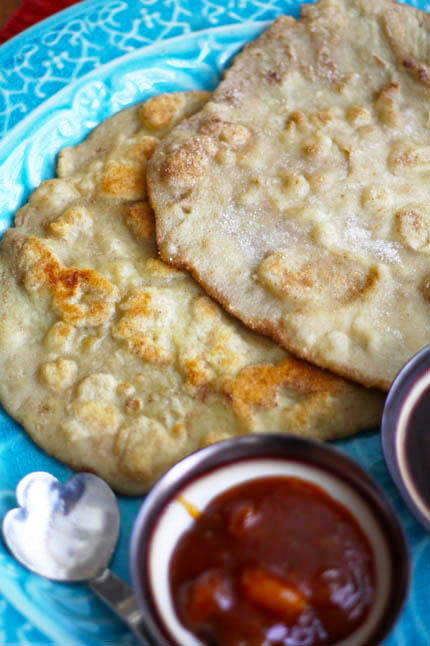
g-f-naan154

This past week I got together with 3 enthusiastic bread bakers.  I’d brought two buckets of dough to work with; the master recipe from ABin5 and the gluten-free brioche from HBin5. From those two buckets we baked everything from an epi and sticky buns to flatbreads like pita, pizza and naan. Out of a request for quick breakfast ideas to feed their kids (some of whom are on gluten-free diets) we experimented with making the gluten-free brioche into a naan. Rolled out in sugar and fried up in butter it was fantastic. The brioche cooked in this way had a crisp caramel coating with an almost pudding like interior. It was so good and easy that it got me thinking about making a more traditional version of naan with the gluten-free crusty boule dough I had left over. It was every bit as delicious as the naan made with our wheat doughs and still as quick.

I also experimented with freezing the gluten-free doughs. Several of you had wondered if this was a possibility since we only recommend refrigerating it for 5-7 days. At the bottom of this post you will see how that experiment turned out. Read More
Stone just broke! What did I do wrong?

Return to FAQs page

Short answer:  Nothing.  I’ve found that stones do not last forever, though my first one lasted through 11 years of daily baking. It seems clear that the 1/2-inch thick ones are very durable, and and some brands (not all) of the 1/4-inch thick stones are less so.

Incidentally, you can often use the broken pieces of the stone, depending on the size and shape of the fragments.

Alternatives to these ceramic stones include the newer cast-iron pizza “stones,” or even just a cast-iron skillet, which I’ve found work quite nicely.  Or try a Dutch Oven or a baking cloche, though my best guess is that cloches, being ceramic, are eventually going to break like the stones.  Iron, definitely not–these should never have a problem with cracking.

For a review of stones, click here. More in The New Artisan Bread in Five Minutes a Day, and my other books.

Note: BreadIn5.com is reader supported. When you buy through links on the site, BreadIn5 LLC earns commissions.

Return to FAQs page

My shaped loaves don’t seem to rise much before it’s time for the oven. What am I doing wrong?

Return to FAQ page

In my method, proportionally more of the rise comes from “oven spring,” rather than “proofing.”  Traditional bread methods get more proofing rise than we do.  Proofing is the time that the shaped loaf spends just sitting and waiting for the oven.  Oven spring is the sudden expansion of gasses within the pores of the loaf that occurs upon contact with the hot oven air and the stone or other hot surface that you might be using.

Don’t be surprised if you don’t see a whole lot of rise during proofing with our method. You’ll still get a nice rise during the oven spring, so long as you didn’t over-work the dough while shaping.  Make sure your oven’s up to temperature by checking with a thermometer like this one on Amazon.  If the oven is too cool or too hot, you won’t get proper oven spring.

If you’re still not happy with the final result– if it seems to dense and under-risen, check under “Dense Crumb” FAQ.

More in The New Artisan Bread in Five Minutes a Day, and my other books.

Note: BreadIn5.com is reader supported. When you buy through links on the site, BreadIn5 LLC earns commissions.

Return to FAQ page

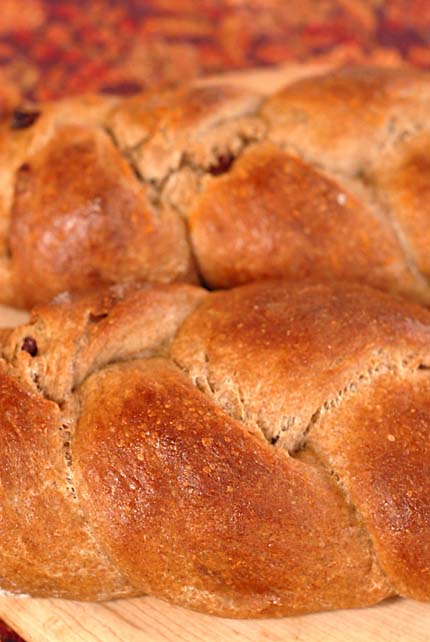
Whole Grain Challah With Cranberries and Orange Zest

2-challahs-not-sliced1

Our new book has a terrific braided challah with whole wheat and wheat germ, and I’ve been playing with a variation that includes cranberries and orange zest.  This same challah recipe lends itself to many other holiday traditions as well, forming the basis in our book for Scandinavian Christmas breads like Pulla and Julekage.  It’s really just a lightly enriched yeast dough that is very, very versatile.  The recipe… Read More

Gluten-Free Crusty Boule

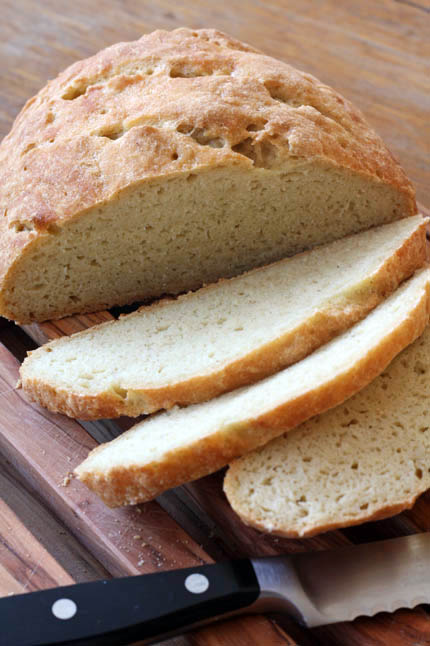
gluten-free-boule-13a

Gluten-free breads were a major request from readers of Artisan Bread in Five Minutes a Day. The options for buying gluten-free bread are both unsatisfying and expensive. So here is a wonderful bread that anyone, celiac or not, would want to eat.

Several readers have asked about the olive oil dough on page 302 of The New Healthy Bread in Five Minutes a Day. While the Crusty Boule (page 299 in the book) has a chewy and toothsome texture, the bread made with the olive oil dough has a much lighter, almost fluffy interior. Replace the neutral flavored oil in the Gluten-Free Crusty Boule recipe with olive oil if you prefer the texture of that loaf. They are both wonderful and give you fantastic options for free form loaves, sandwich breads, pizzas and even crackers. You will find all of these, plus many other gluten-free breads and awesome sticky buns in the book, with the link above.

For those of you who are celiac or just baking for someone who is you will find all of the directions and tips for handling gluten-free dough below. It is just as easy as the other recipes, but requires slightly different techniques and a new list of ingredients. Read More

Storing bread: What’s the best way?

Return to FAQs page

We try to make only enough bread to eat on the same day, but if you have leftovers, the best way to store homemade bread is unwrapped and cut-side down on a non-porous surface like a plate, at room temperature (not in the refrigerator).  This preserves the crust a little more than if you put it into a plastic bag, which softens the crust very quickly.  The exception is pita bread, which is soft-crusted in the first place and is great in a plastic bag–but wait till it cools before bagging.

How long can you store bread this way? Maybe 24 hours. You can extend that a little if you put it in a plastic bag (refrigeration optional), and it’s often OK for toasting a day or two later.

More in The New Artisan Bread in Five Minutes a Day, and our other books.

Note: BreadIn5.com is reader supported. When you buy through links on the site, BreadIn5 LLC earns commissions.

Return to FAQs page

Can I use your recipes on my website, in my class, or in a publication?

Return to FAQs page

I love it when food-lovers talk about my books or website content on their own websites, in classes they teach, or in publications.  I get lots of questions from them about whether they can use these recipes or other material.  The answer is a little complicated.  I can’t extend written permission to copy recipes, text, or even Q&A material from my books or website.  That would be seen as waiving my copyright, which my publisher tells me I can’t do.  But, the recipes can be used, in modified form.  Here’s how my publisher and I understand copyright law, and this is what we’d ask you to do if you want to teach your own readers my recipes:

1.  Copyright law prohibits you from using text from the books or website without expressed written permission (which my publisher, Macmillan, has advised against).  It also prohibits you from copying recipes or Q&A into your website, class materials, printed books, magazines, electronic books, or elsewhere.

2.  My first choice is that you only use your own photos, that you’ve taken of my breads. Then, refer people here to my website or to our books in order to get the recipes. That said, copyright law allows you to use modified versions of my written recipes. This applies to websites and to printed materials.

3.  Photographs from the books and on this website are copyrighted and cannot be used without expressed permission. To arrange special permission in specific circumstances, please contact us through this website.

4.  Please mention my books and website (BreadIn5.com) as sources for the full and original versions of the recipes.

Thanks for your enthusiasm!

Note: BreadIn5.com is reader supported. When you buy through links on the site, BreadIn5 LLC earns commissions.

Return to FAQs page

Cornell Bread

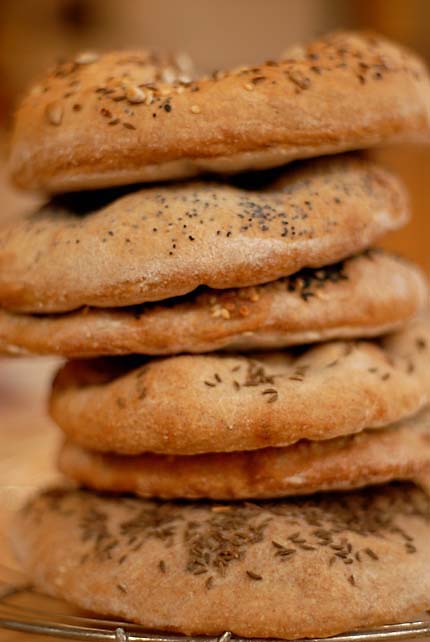
pitas-on-edge

Return to FAQs page

(… and a recipe for pitas from so-called “Cornell” dough).  Our third book will be officially released on October 25, 2011, but it’s now available for Pre-Order on Amazon! To view the book’s cover, which is now finalized, click here. It will have pizza and flatbreads from all over the world—plus, the recipes will be complemented with soup, salad, and dip recipes so that these pizzas and flatbreads become the basis of an entire five-minute meal.  As in all our books, the idea is to do all the mixing once, but serve many times from a big batch.  That’s a perfect fit for soups and dips (and you can get a salad ready while your bread’s in the oven).

Turns out that you can make great flatbreads (like the pitas above) using a modification of our Whole Grain Master Recipe (that original appears in Healthy Bread in Five Minutes a Day).  The modification was inspired by “Cornell Bread,” a bread baked from soy-enriched dough originally developed as a vegetarian protein source during World War II.  Many of you have asked us about whether our recipes work with some soy flour— they do…          Return to FAQs page, or scroll down for more on Cornell Pitas…

Read More

Pizza Lollipops ~ The Movie


Here is a fun video Jeff and I made with Jennifer Samuel from Unplanned Cooking about the ever popular pizza-on-a-stick. This version was made with the whole grain master recipe from HBin5 with classic pizza toppings rolled inside. It is an easy, quick and healthy snack for kids after school or a great idea for your New Year’s Eve Party.

pizza-on-a-stick10

Thank you Jennifer for the use of your wonderful video!

Click here for the recipe.