Corrections for Healthy Bread in Five Minutes a Day

Early editions of Healthy Bread in Five Minutes a Day had some errors sneak through; all were corrected in later printings:

Page 65 (Step 5 in “Whole Grain Garlic Knots with Parsley and Olive Oil”):  Add the words “Sprinkle grated cheese over the knots.”

Page 79 (Ingredients list for “100% Whole Wheat Bread, Plain and Simple”): The list says you can swap whole grain spelt flour for whole wheat in this recipe, but unfortunately, spelt flour isn’t yet standardized across the market, and some readers find that their brand doesn’t absorb as much water as typical whole wheat flour, resulting in a dough that’s too wet. If you’re finding that, add in additional flour until you have a dough that’s about the usual consistency for what you’re getting in the book, or in this video.

Page 109 (intro paragraph): Second sentence should read “By blending cracked wheat with whole wheat flour and all-purpose flour, we produced…”

Page 174 (Ingredients list for “Four-Leaf Clover Broccoli and Cheddar Buns”): Quantity for vital wheat gluten should read “1/4 cup” (not “1/4 tablespoon”)

Page 177 (Ingredients list for “Sweet Potato Spelt Bread”): Quantity for water should read “3 cups” (not “3 1/2 cups”)

Page 271 (Step 4 of “Milk and Honey Raisin Bread”): “… use over the next 5 days (not 10).  Or store the dough for up to 2 weeks in the freezer in loaf-sized portions.”

Page 275 (Ingredients list for “Whole Wheat Brioche”): Quantity for vital wheat gluten should read “1/4 cup” (not “2 1/4 cups”), and quantity for lukewarm water should read 2 1/4 cups (not “2 cups”)

Also note, sometime after the publication of the book, the Williams-Sonoma company stopped offering a lifetime replacement guarantee against cracking of its baking stones, so we can’t recommend their product anymore (see page 29).

Note: BreadIn5.com is reader supported. When you buy through links on the site, BreadIn5 LLC earns commissions.
Panettone for the Holiday!

pan03sml

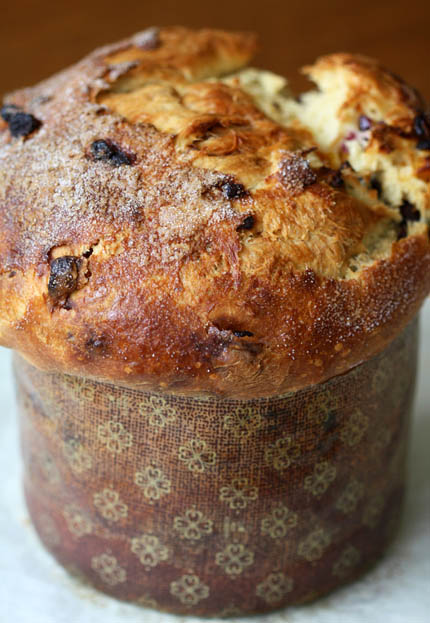
Panettone was traditionally a Christmas bread sold all over Italy during the holidays. It finds its origins in Milan around the 15th century, and has been the subject of much romantic lore.  The most often told story of how this bejeweled bread came to be goes something like this.  A young nobleman by the name of Ughetto Atellani fell in love with the daughter of a poor baker named Toni.  In order to impress her, Ughetto disguised himself as a pastry chef’s apprentice in her father’s bakery. He creates a tall fruit studded bread to present to her father, calling it “Pan de Toni.”  The bread, rich with eggs and butter, sweet with honey, scented with vanilla and lemon zest, with the finishing touch of dried and candied fruits was a success in the bakery and wins the admiration of the lady and the father’s respect. The baker blesses the marriage and Ughetto marries the daughter.
The story is rich and fanciful, just like the bread.  Today this sweet loaf is no longer saved just for Christmas, it is eaten at other holidays throughout the year and served sliced and toasted for brunch and as a dessert with a selection of cheeses and sweet wines. The bread, despite its rather lighthearted lore is quite sophisticated. The traditional method for making panettone is done over the course of several days. It included long sessions of kneading and allowed for up to 20 hours of rise time in order to create a flavor that is both sweet, but also has a complexity caused by the fermentation of the dough. Today, we want the same balance of flavor, without having to labor over the process or wait several days to enjoy our bread. Although you can bake the bread after only a couple of hours of refrigeration we recommend letting it sit for about 24 hours to develop its full flavor.
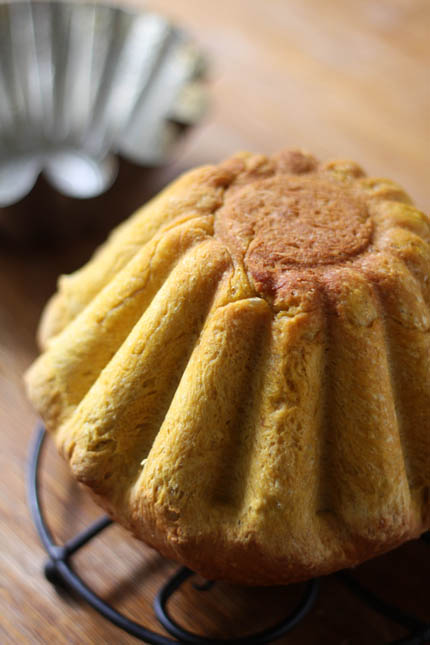
There are traditional Panettone molds that are very high sided which come either straight or fluted, they give the bread its characteristic cupola shape.  These molds can be found in either metal Panettone-Charlotte or Paper Moulds varieties at cooking stores or on the web.  We have also used a Brioche Molds, and many people bake them in large, empty, parchment lined coffee cans to achieve the high domed loaf. Read More
How’d That Fresh-Ground Whole Wheat Store? Report at 15 Days

15-day-loaf

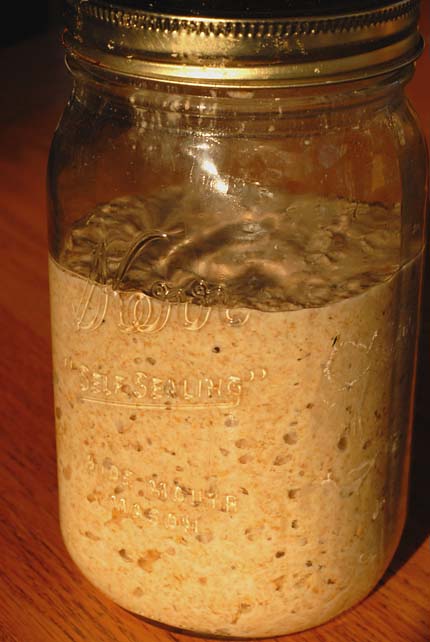
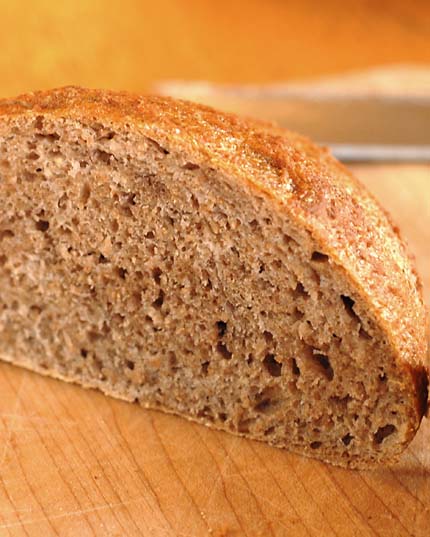
Back on November 11, I posted about my experiences with fresh-ground whole wheat, and I promised I’d come back and let you know how the dough stored.  Short answer:  pretty well.  I baked off some of the dough on day 10 of the batch-life, and it did beautifully.  Here, pictured above, is the same batch on day 15, which is a day longer than we usually recommend.  I had a feeling that it was going to be OK when I took the jar out of the fridge (remember, don’t screw the top down if you store dough in jars– gas is still being produced and this could cause a hazard).  You can still see some decent hole structure:

in-jar

So, I’m liking this fresh-ground wheat.  Very curious as to all your experiences with it.

Follow us on Twitter:  https://twitter.com/ArtisanBreadIn5

Sourdough Starter in our Recipes

Return to FAQ page

Yes, you can use activated sourdough starter in our recipes. My own sourdough starter (see link), after I activate it from the fridge, is about half water and half flour (you can find recipes for naturally-fermented sourdough starter all over the web, and one of our future books may have a recipe of our own). I’ve found that about 1 1/2 cups of activated sourdough starter works well in our full-batch recipes, which make 4 to 5 pounds of dough. This means that you need to decrease the water in the recipes by 3/4 cup, and the flour by 3/4 cup. At the end, you’ll probably need to adjust water and flour to create a dough that looks and feels just like what you get with our yeast-based recipes.

So, having done this, do you need to use commercial yeast in addition? I found that I still needed some yeast in the recipe, though I could use a lower dose, which I’ve posted about before in the context of our yeast-risen recipes. That seems like a good compromise. I did experiment with zero-yeast versions, but I found them a bit temperamental– didn’t store terribly well so we decided not to put that in our books… yet!

More in The New Artisan Bread in Five Minutes a Day, and my other books.

Return to FAQ page

Thanksgiving Stuffing from Homemade Bread

boule-cover

(photo by Mark Luinenburg)

We’re spending Thanksgiving with friends this year, and our family is doing the stuffing and bread for a table for 25.  Sounds like a job for a household where they bake bread twice a day anyway…

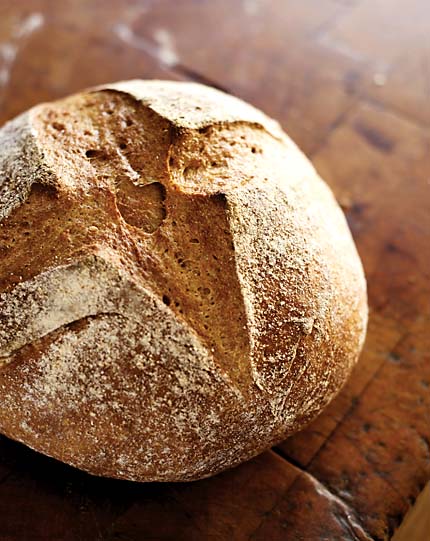
I’m making the stuffing from basic boules, ball-shaped breads as above.  You can use any lean dough you like, including whole-grain dough from the new book.  Tomorrow I’ll be using the Peasant Bread from my first book, which is basically the white-flour Master Recipe, swapping out 1 cup of whole-grain rye for 1 cup of all-purpose flour.

Breads for the table are going to be a mix of seeded and unseeded rye breads, very rustic, maybe Anadama bread from the new book.  All we’ll need is the belt-buckles on our hats.

Two other Thanksgiving recipes from the “library” are:

Thanksgiving Buns and Other Helpful Holiday Hints

Thanksgiving Cranberry Corn Bread

OK, let’s make some stuffing… Read More

Pumpkin Pie Brioche just in time for Thanksgiving!

pumpkin-brioche-06-small

Pumpkins are associated with the quintessential Thanksgiving dessert, a decadent pie filled with spices and sweetness. The pumpkin adds a smooth and luxurious texture that amounts to pure comfort food. Pumpkin is not only wonderful for its flavors but is also chock full of healthy vitamins. This was the inspiration for making a pumpkin pie brioche to include in Healthy Bread in Five Minutes a Day. It can be baked as a loaf, in a brioche pan or even made into our Indian Spiced Doughnuts (page 287) or as the bottom crust for the Pear Tarte Tatin (page 290). It is fabulous as dessert or breakfast.

Read More

Thanks Peter!

Peter Reinhart is the dean of American bread bakers, possibly the best in the world.  He teaches baking at Johnson & Wales University in Providence RI, has written six books on bread baking, and has won the James Beard and IACP Cookbook of the Year awards.  On any given day, he’s flying around the world spreading the gospel of great bread– Peter’s an international authority on my favorite subject.

So I was pleased to see his latest book, Peter Reinhart’s Artisan Breads Every Day, which was released on October 27, 2009.  Here was a world authority giving his take on super-fast bread (he doesn’t store his dough so it’s very different than what we do in Artisan Bread in Five Minutes a Day and in Healthy Bread in Five Minutes a Day).   Peter acknowledged our books and the quality of our results in his own book.  Here’s what he had to say in Peter Reinhart’s Artisan Breads Every Day:

Page 7:  “… when I first read the instructions for the master hearth bread recipe in a recently published book, I immediately assumed, based on my understanding of dough science, that it contained way too much yeast to work as promised.  How could it possibly last in the refrigerator for even one day without overfermenting while the yeast gobbled up all the released sugar?  How could it possibly create a tasty, moist, and creamy loaf (what some describe as the custard-like quality found in great breads)?  Yet, when I made the recipe, it worked and didn’t overferment.  Sure, I saw areas where the recipe could be tweaked and improved upon, but this didn’t diminish my astonishment at how greatly it exceeded my expectations. Although I have yet to find a scientific, chemical, or biological reason to explain why it works, the results forced me to reconsider all of the premises I once held sacrosanct…”

In case anyone’s wondering if Peter’s really talking about our method, turn to page 204 of his book, where he acknowledges our first book by name, as a resource, and again mentions our “excellent results.”

Thanks Peter!

Using Fresh-Ground Whole Wheat Flour (and some highlights from book tour)

scoopers-of-flour

Return to FAQ page

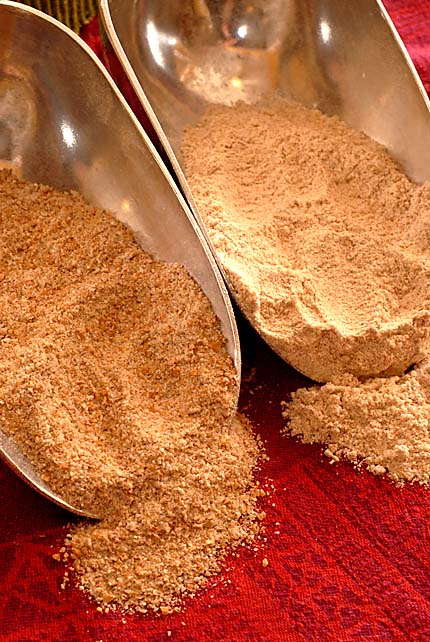
The flour on the left (the browner, coarser one) is an organic fresh-ground (aka fresh milled) whole wheat.  On the right, the commercial whole wheat flour is obviously finer-ground and lighter in color (it’s the Dakota Maid brand, a very consistent and tasty product).  So many of you have asked about grinding your own wheat to make whole grain breads, that I decided to try it myself.

OK, I didn’t really grind it myself, I sourced fresh-ground wheat from a local miller. The flavor’s terrific.

It’s not an absolute requirement for whole wheat bread, but here’s a little on my first experiments with this great flour.  Considering how different the fresh-ground product looked compared with commercial whole wheat, I was surprised at how easily this stuff was able to be used in one of my whole-grain Master Recipes— with no changes.  After some whole wheat talk, a little about the West Coast leg of book tour (Seattle, Portland, and San Francisco).  Read More

Whole Wheat Brioche from The New Healthy Bread in 5 Minutes a Day!

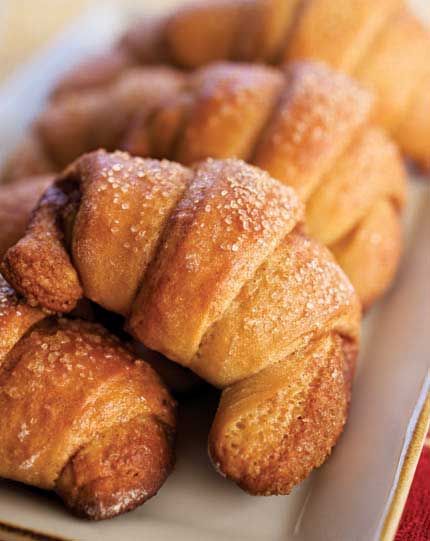
Cinnamon Crescent Rolls with Whole Wheat Brioche
Photo by Mark Luinenburg

For The New Healthy Bread in Five Minutes a Day the idea was to offer a variation of sweets and enriched breads, but they had to fit with our goal of healthier ingredients. This meant less white flour, less sweeteners, less fat and yet still delicious, tender and rich. The full recipe is in the book, with weight-equivalents for the measures in grams and pound/ounces.

Read More