Master Recipe from “New Healthy Bread in Five Minutes a Day” using Vital Wheat Gluten!
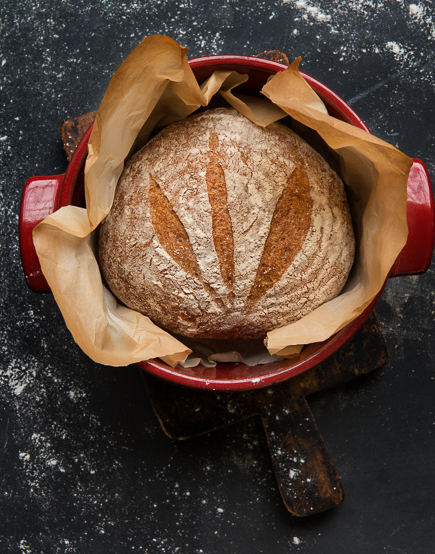
(The pictures in this post are by Stephen Scott Gross, who did the photography For New Healthy Bread in Five).
After writing the first edition of Artisan Bread in Five Minutes a Day in 2007 I was immediately asked how to convert the recipes to whole grains, and maybe even gluten-free equivalents. Through quite a lot of other adventures, the updated version has come out: The New Healthy Bread in Five Minutes a Day: Revised and Updated with New Recipes.
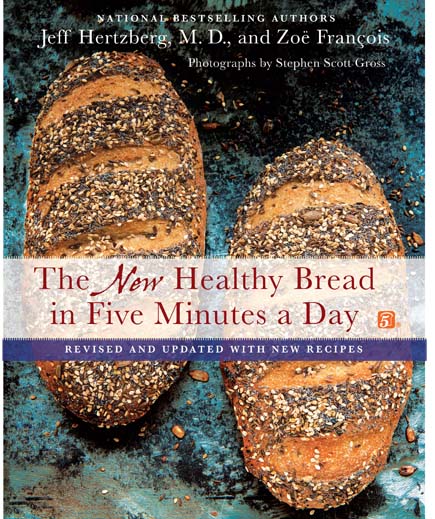
There are more photos to inspire you and make baking easier, all the recipes are in cup measures and weights, since we love baking with a scale and we’ve added charts for different kinds of flour, since there are so many on the market to choose from. And there’s a vast chapter of tips and techniques. Here’s a summary of what’s new in the new edition:
- Using sourdough starter as a leavening agent: for the first time in any of the books, instructions on creating your own starter and then using it as the leavening agent for homemade bread. Yeast bakers still have our original instructions as well.
- Weight equivalents for every dough recipe. Weighing’s more accurate and it’s catching on in the U.S. We’ve really made leaps and strides as a baking country since 2007 (when the first book was launched), because inexpensive digital scales have become available everywhere.
- Versions and options for omitting vital wheat gluten: Some of our readers asked how they could omit this from the recipes in the original Healthy Bread in Five Minutes a Day—which all called for added gluten. I’ve done that for the Master Recipe, and given some rules of thumb for doing it for the rest of the book as well (it’s a water adjustment).
- Using offbeat or ancient grains like spelt, Kamut (khorasan), and sprouted wheat: New rules of thumb for water adjustment when you use alternatives to standard supermarket whole grain flours.
- Other new ingredients that have started appearing in American pantries: Coconut and flaxseed oils work great in the recipes calling for oil.
- A gluten-free chapter: It has all the favorites from the book’s first edition, based on positive feedback from readers.
Now let’s dive into our Master Recipe, which didn’t change much, because it works so well and it is a great place to start for people who aren’t used to baking with whole grains. With whole grain baking you need more water, and one extra ingredient called Vital Wheat Gluten (sometimes labeled “vital wheat gluten flour”), which is available in most supermarkets, or mail-order/on-line from anywhere…
Whole grains can make for a drier results; all that bran soaks up water. So we increased the water for all the new recipes. But that was only part of it. I found that boosting the gluten content with vital wheat gluten increased the amount of time we can store the dough. Storing the dough is why these recipes are different from all others and makes baking so fast. Vital wheat gluten makes whole grain dough springy enough to be stored in the refrigerator as a large batch. There’s also a version without vital wheat gluten in the book for those who prefer not to use it or can’t find it.
What is vital wheat gluten? It’s the protein-rich part of wheat that creates the strands that trap gas bubbles and allow yeasted bread to rise (and stay risen). It doesn’t take much vital wheat gluten to make a difference in a 4 to 5 pound batch of whole grain dough. Just 2 to 4 tablespoons are all you need, so while the whole bag or box may seem expensive, it doesn’t add much to the cost of baking.
So where do you get vital wheat gluten? Most supermarkets in larger towns and cities carry it. The two brands in U.S. supermarkets are Bob’s Red Mill and Hodgson Mill, and we tested those extensively. If your local store doesn’t carry vital wheat gluten, you can mail-order it from Amazon; click for either the Bob’s Red Mill product, or the Hodgson Mill product (you can also order directly from those company’s websites).
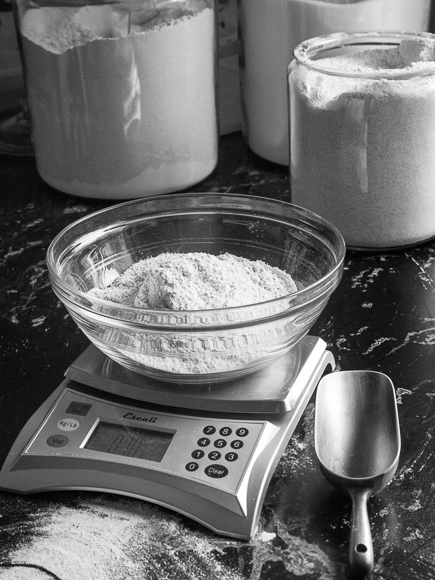
Master recipe from The New Healthy Bread in Five Minutes a Day:
There are many, many more details are in the book, along with plenty of recipes that are 100% whole grain; this recipe is about 73% whole grain:
Ingredients:
5 3/4 cups (750g) whole wheat flour – This is based on typical supermarket whole wheat, but we have a chart in the book so you can easily bake with King Arthur, Bob’s Red Mill, Sprouted Wheat, Kamut, Einkorn, Spelt or Hodgson Mill.
2 cups (300g) unbleached all-purpose flour
1 tablespoon (10g) granulated yeast – can decrease. You can use any kind of yeast including: instant, “quick,” rapid rise, bread machine, or active dry. You can also decrease the amount of yeast in the recipe by following the directions here. Or you can bake with a sour dough starter, see instructions here.)
1 tablespoon (15g) Kosher salt – can adjust to taste or health concerns
1/4 cup (40g) vital wheat gluten (or vital wheat gluten flour) – Here is a version without vital wheat gluten
4 cups (910g) lukewarm water (about 100°F)
1 to 2 tablespoons of whole seed mixture for sprinkling on top crust: sesame, flaxseed, caraway, raw sunflower, poppy, and or anise
To make the dough:
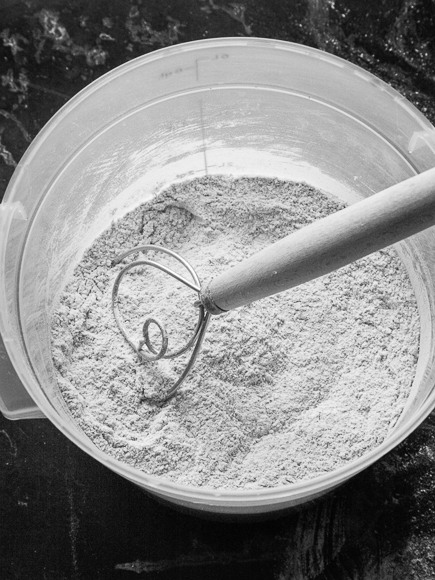
First, measure the dry ingredients into a 6-Quart Round Container or bowl, and whisk them together (you can also use a fork, or if it’s lidded, just shake them well). Mixing the dry ingredients first prevents the vital wheat gluten from forming clumps once liquids are added.
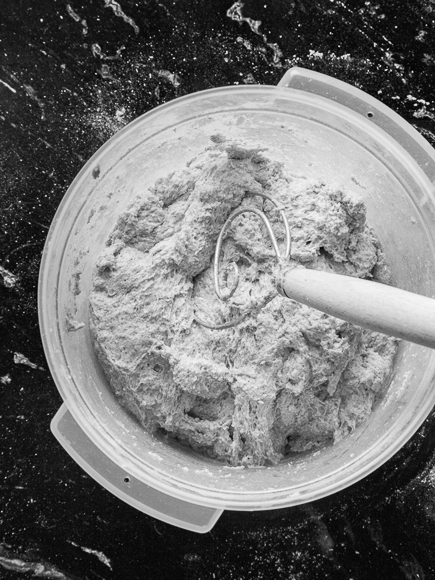
Add the water to form a wet dough and mix with a Danish Dough Whisk or wooden spoon.
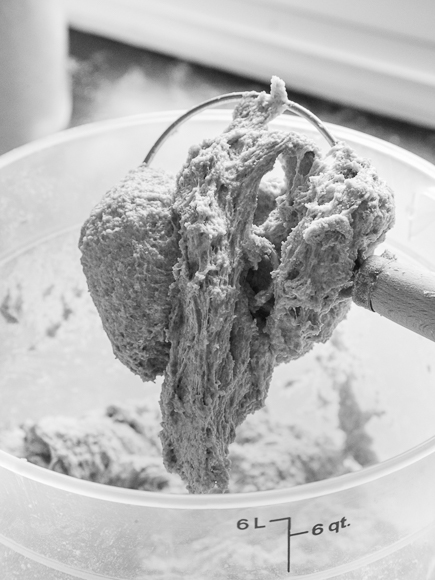
Don’t add additional flour to dry this out. It should be wet and shaggy.
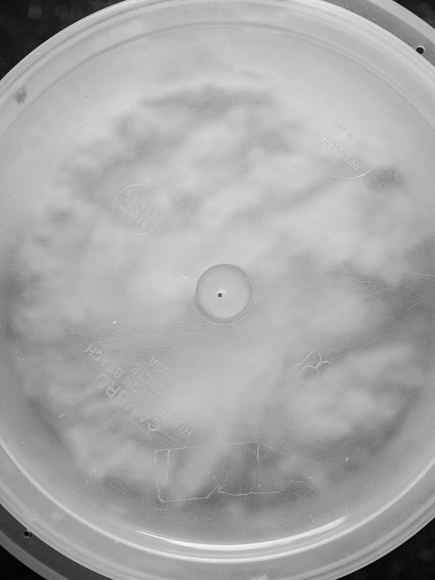
Cover loosely (leave lid open a crack) or you can piece a small hole in the lid, as you see above. Allow to rise for two hours at room temperature (if you decreased the yeast, you’ll need more time). NEVER PUNCH DOWN. The dough will rise and then begin to collapse. Refrigerate and use over the next 14 days, tearing off one-pound loaves as you need them.
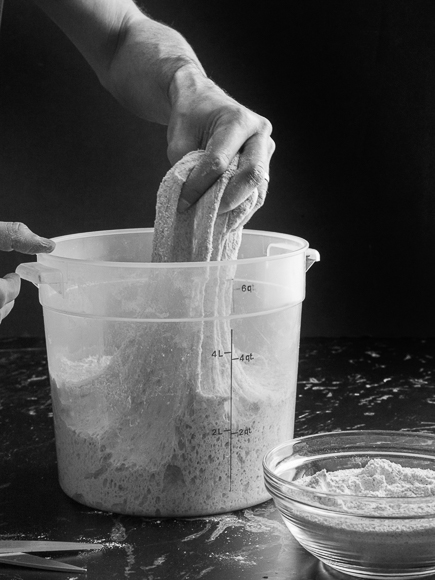
On baking day, cut off a grapefruit-sized piece of dough (about a pound), using a serrated knife or a Kitchen Shears.
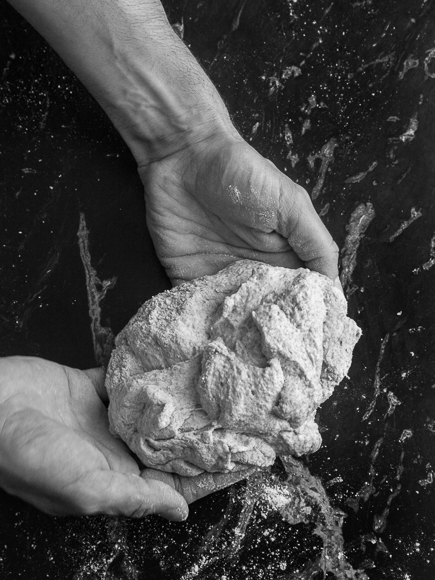
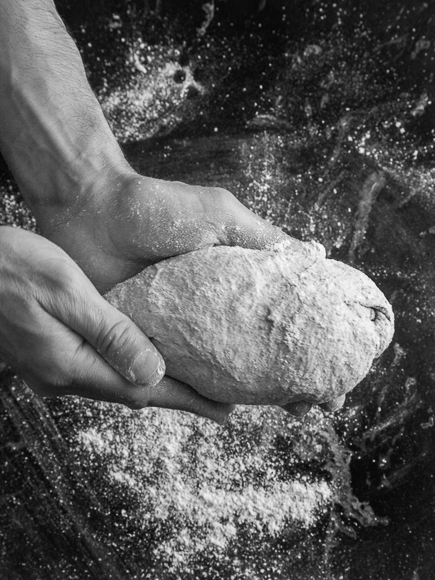
Quickly shape a loaf as you’ve seen in our videos on this website.
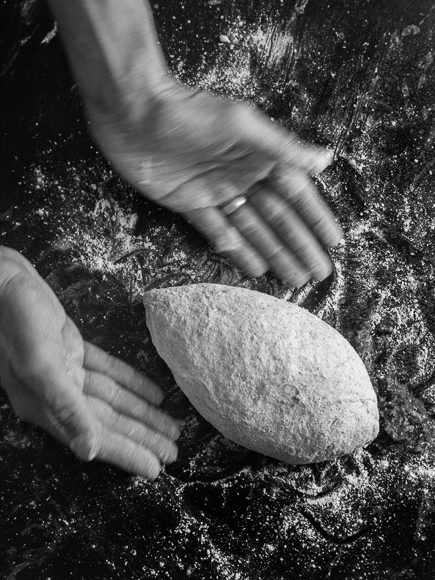
It should take less than a minute— you pull the top around to the bottom, rotating quarter-turns as you go. DON’T KNEAD or otherwise knock all the gas out of the loaf.
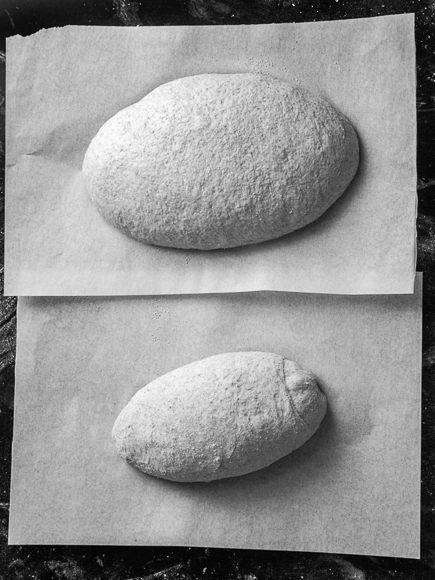
Cover the loaf loosely with plastic wrap and let it rest on a pizza peel covered with cornmeal or parchment for 90 minutes (40 minutes if you’re using fresh, unrefrigerated dough.) Depending on the age of the dough, you may not see much rise and it may spread out. The bottom loaf in the photo is just after shaping and then the one above it has rested and is ready for baking. Our loaves depend more on “oven spring” for rising.
Preheat the oven to 450°F (230 degrees C), with a baking stone placed on a middle rack. Place an empty broiler tray for holding water on any other rack that won’t interfere with rising bread.
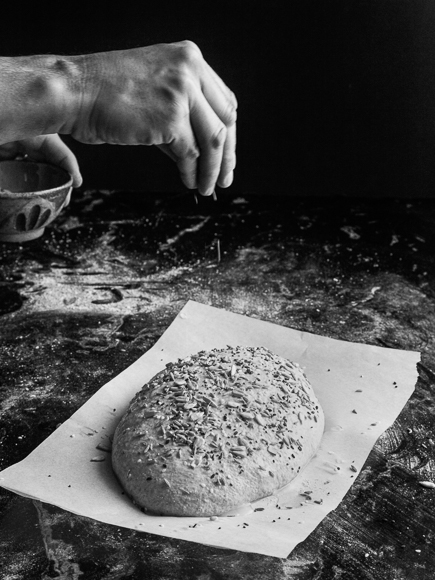
Just before baking, use a pastry brush to paint the top with water (we’ve dropped the cornstarch wash) and sprinkle with seed mixture.
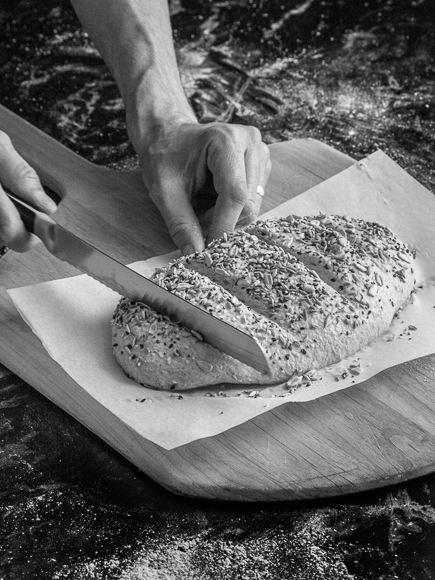
Slash the loaf with 1/2-inch deep parallel cuts across the top (or a singe lengthwise cut as in the first picture). Use a serrated bread knife held perpendicularly to the loaf:
Slide onto the hot stone…
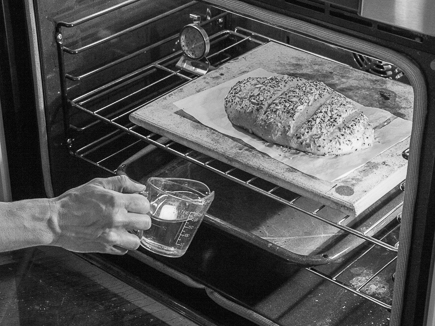
…and carefully pour 1 cup of hot tap water into the broiler tray (in the book, we give alternatives for creating that steam environment, which is essential for creating a great crust):
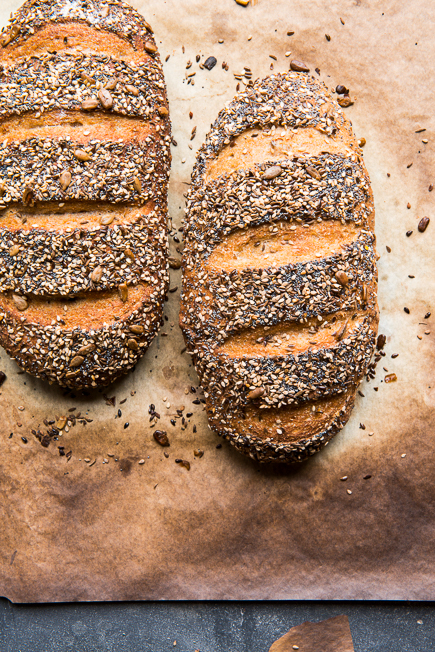
After a 30-minute bake, cool on a cooling rack.
Here are more shapes and ways to bake our Master recipe:
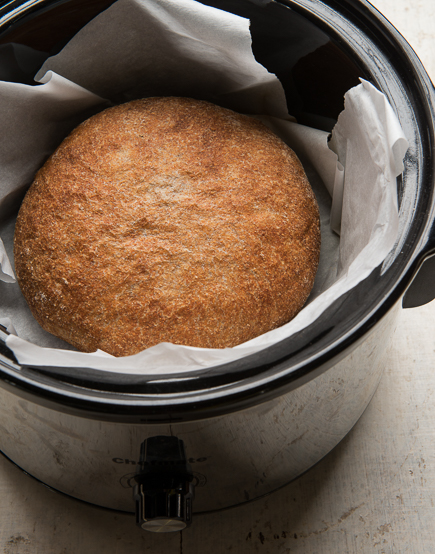
Slow Cooker bread from our Master recipe
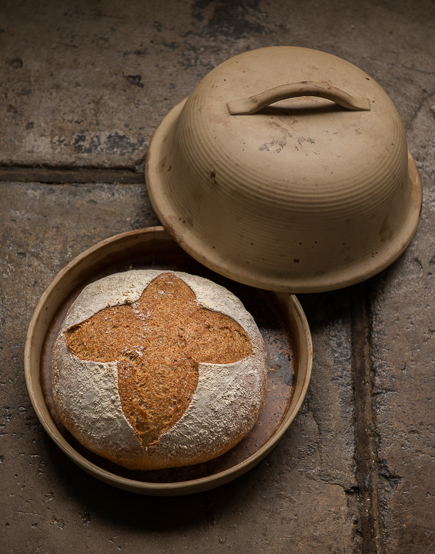
Master recipe baked in a Cloche
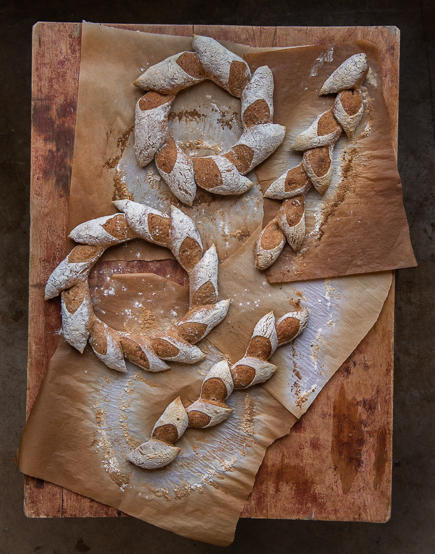
Epi and wreath from Master recipe
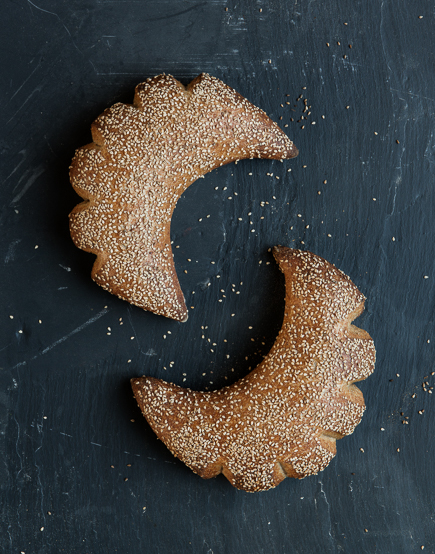
Moon and stars made from Master recipe. And there are many more in the book, plus 100 other recipes.
Note: BreadIn5.com is reader supported. When you buy through links on the site, BreadIn5 LLC earns commissions.
Good day Jeff and Zoe, I just wanted to tell you how much I LOVE Healthy 5 minute bread book. I am soo inspired and I know my reader will be too. So thank you Clarice
Thanks for the kind words, Clarice, come back w/questions anytime. Jeff
Hey Jeff and Zoe!
I have posted about the shipping stuff, along with two other posts on what I have tried and what experiments I’m considering trying. I’m thinkin’ banana brioche…? 🙂
Ms. B
Hi Ms. B,
There is a Banana bread in HBin5, which is fantastic! Great minds think alike! 😉
Enjoy, Zoë
LOVE the new book! I pre-ordered and it was scheduled for delivery on Thursday . . . and my waiting was anything but patient. Dad walked in the door after work Wednesday with a package . . . my new book!!
Yesterday we used the WW master recipe for pizza on a stick (without the stick) and I have a batch of the German whole grain bread sitting on the counter. I also just agreed to mix up a batch of softer dough to make cinnamon rolls for church pot-luck tomorrow . . . . good thing you both know bread so well, or I’d be in a pickle. 🙂
A friend just found out her husband has to switch to a more whole grains diet, so I will be taking my copy of your new book to her as soon as she gets back from holiday. I so love sharing this goodness.
Thank you so much!
CJ
Hi CJC,
That is wonderful! It sounds like you have as many buckets of dough going as I do!
Enjoy, Zoë
You two changed the way I think about making bread at home with your first book. I can’t wait to get my copy of your new one next week in SF. See you at Foodbuzz! 🙂
Hi Joy,
I can’t wait to see you at foodbuzz! See you soon!
Zoë
Gratz on the new book. Got both copies of the new one, & am covering the kitchen in flour getting new batches made up 😉 BTW have been showing off my pics on facebook of beautiful bread from the first book….Lots of ppl have been asking me about recipes, even people who have never baked. Many good wishes for all your hard work 😉
Congrats on the obvious success of your second book! I finally ordered it (such a procrastinator) but am going to get started on the master today, so thanks for sharing it here. Reading through everyone’s questions here has been great for troubleshooting, too. Looking forward to seeing you both at the FoodBuzz Festival!
Hi. In the four-leaf clover buns recipe on page 174 of the new book, should that be 1/4 cup or 1/4 tablespoon of vital wheat gluten?
Joni: Thanks for the kind words!
Kellypea: FoodBuzz is going to be fantastic, hope we can connect there.
Robert: 1/4-cup is correct, sorry about that, looks like you guessed the correct answer.
Jeff
tried this 73% recipe, but bread was very dense, little rise on the counter or oven spring.
When i cut off the ball to bake, it didn’t stretch at all like in your picture, it just came off the dough in the bucket in a clump.
Do you think the problem could be that I used coarsely ground whole wheat flour?
What can i do to save the dough that’s left?
Hi Amy,
It very well could be the coarsely ground flour that you are using. The bran in flours like that tend to act as little saws which cut the gluten strands and can make the bread denser. If you want to use the course flour, you may have to play with using more VWG in order to get that stretch you want. Perhaps consider a combination of wheat flours to achieve the flavor you want and the texture.
I hope that helps! Zoë
The master recipe whole wheat bread is absolutely delicious. I had it this morning with some sheeps milk cheese and it was yummy.
Thanks for getting back to me, Jeff! It’s very much appreciated.
I use have used Gold Medal whole wheat flour in the past, but not with the vital wheat gluten, so I’ll give that a go. I’m using the scoop and sweep method, and when I made the WG master recipe, I did mix the gluten into the flour before I added the water. It gave the dough a little more rise, but not much- should I add more? I’ve also tried the Light Whole Wheat bread from the first book, and the Whole Wheat Sandwich Bread Inspired by Chris Kimball. I have made the latter several times (my kids love it, rise or not!) and tried different resting times and rise times, without much luck.
Thanks for the help!
Thanks for the reply, Jeff. I have asked Amazon to ask the publisher to make a Kindle version available. I agree with Kylie’s comments about the differences between the Kindle and print versions. In addition, the Kindle version is handy for showing people the book when not at home or in a bookstore.
I am looking forward to trying the gluten-free versions for others in the family.
Thanks!
I have been milling my flour for a long time and would like to use fresh milled for your recipes. Have you experimented at all with it? I think it soaks up more liquid than the preground. Also, I wonder if it’s possible to grind it and store it in the freezer a few days before using. I don’t know if that would make a difference or not. Ok, well, hope you have a perspective on that 🙂 thanks! Cindi
Cindi: More to come on this– yes, it soaks up more water, but I haven’t tested it myself yet. Will post on this sometime before winter. Jeff
I just got the new book on Saturday and am about to make the Vollkornbrot. It’s in the pan for its rise, but I am a little confused wrt the instructions. I am to place a baking stone in the middle rack and the broiler tray (for steam) on another rack (I use the bottom rack for this). Then I am supposed to place the loaf pan in the center of the oven. I assume that means on top of the baking stone. Am I correct? I don’t know that I’ve ever placed a PAN on the stone, just a freeform loaf. But I only have 2 metal racks in my oven!
Petra: The idea was to must place the bread near the middle, and the water tray anywhere else. It can be on top of the baking stone if you have room, or with a loaf pan, you can omit the baking stone. I like the stone, it evens the heat, and even improves pan breads.
Piggy-backing on my own last message–I made the Vollkornbrot. My, that was the heaviest loaf of bread I have made in my life. It was also the first 100% whole grain bread I made that tasted fab! I feel so virtuous eating a slice (or three). After the 36-hr. refrigerator rest, the wheat berries really did soften up. I did replace the rye flakes with old fashioned oats (had them on hand). Thanks Jeff and Zoe
I just love having fresh dough in the fridge, ready to play with! Question: I bought a Nutrimill (home grain mill) and a bucket of white whole wheat. Can I use freshly milled wheat in your recipes without alteration? Thank you.
I ried the whole wheat banana bread recipe and it is fabulous. Not like the usual too moist and too sweet variety. It has a lovely texture and the banana flavor is there but not overpowering–much more subtle and flavorful.
Hi Clarice,
I’m so thrilled that you tried the banana bread! I love it too! 🙂
Thanks, Zoë
Our local newspaper recently printed your master dough recipe and as I read through it, I have all indgredients on hand but do not have a “baking stone”. Does this make a difference in the finished product????
Paul– the stone gives you a more evenly-baked and crisp result, but is not absolutely essential. More details in the book, or you can read around in this website for others experiences. Jeff
I had bought the Artisan bread last month and ordered Healthy Bread yesterday. I made my first boule this morning (whipped up the base dough yesterday & let it rest overnight). Wow.
This is really the easiest bread I’ve ever made, even easier than my bread machine.
I would encourage people to get the book. Yes, the blogs & website have a lot of information, but having the book is like hanging out with you in your kitchen while we bake. I really enjoy reading it.
Thanks & keep ’em coming.
Thanks Lara, such a nice note.
Zoe–This morning I had some with Nutella–WoW..C
Hi Clarice,
That sounds fantastic! 🙂
Zoë
If I substitute beer for some of the liquid….How much should I use? Will this produce a yeastier flavor. Love love your books… Jo
I haven’t read through all the comments yet, so I don’t know if someone else has already mentioned this or not. I just received my copy of the new book, and noticed that in your description of spelt you say that you’ve never found a version that isn’t whole grain. You then say a refined version of spelt flour is not being sold in the US. That’s not the case! VitaSpelt makes a white, refined spelt flour, I have been using it for well over 5 years. The natural foods co-op where I shop even has it in their bulk bins. It’s delicious and very versatile, I’ve used it for all kinds of things as a replacement for AP wheat flour. It doesn’t seem to be quite as fully refined as AP wheat flour, it has the odd fleck of bran in it, but whole grain it most certainly is not! I also use whole grain spelt flour, either purchased or ground at home (including some that is made from sprouted spelt), I do know the difference, the appearance, texture and results are totally different. The package also is labeled “white spelt flour” (I’ve ordered large bags of it at times, not just buying it from the bulk bin). I hope people trying to avoid refined flour won’t be confused by this!
I’m excited to try the recipes in the new book. I have been making the first book’s light whole wheat recipe using sprouted wholegrain spelt flour in place of whole wheat flour, and increasing the proportion of that to be about 1/3 of the total flour. The results are amazingly delicious with wonderful texture, even without adding any vital wheat gluten. I hope my beloved sprouted spelt flour will be a successful substitution for whole wheat in many of the recipes in the new book.
I tried the deli rye from your first book with the tip from the new one–just brush with water (forget the cornstarch mix) before sprinking on the seeds. Works just fine–and that is another of my favorite bread recipes.
For whatever reason I cant open your site
healthybreadinfive.com Artisanbreadinfive.com keeps on opening has anyone else complained??
Hey, both sites go to the same location on the internet– they’re the same site, so you’re good:
artisanbreadinfive.com = healthybreadinfive.com
Sorry we missed some of the above on book tour:
Jo: You can swap up to a cup of beer for water, see what you think– less for milder flavor.
Aubin: Not familiar with the product you mention, but if it’s bran-depleted you may need a little less water than we specify. Experiment and see what you think.
Clarice– yep, all will work that way with seeds in either book.
Jeff
Jeff,
There are now also some other brands of white (refined) spelt flour on the market as well, I checked yesterday. Sorry to be confusing, the refined spelt flour is a different product than the sprouted spelt flour I mentioned (which is whole grain, not bran depleted at all). I posted because I don’t want people who do find the refined spelt version to be confused, to think it’s whole grain when in fact it isn’t (because of the comment in the book that there is no refined spelt flour being sold in the US). Obviously, the refined spelt flour would differ from whole grain, both in nutritional value and in the way it behaves in recipes.
Incidentally, I have found with the refined spelt flour I’ve used that it absorbs quite a bit less water than refined wheat flour, a greater difference than I think could be accounted for by the tiny amount of bran left in it. For instance, when I make a pie crust with refined spelt flour, it needs only 4 TBS. of water for a given amount of flour and fat used, when the same recipe made with wheat flour takes about 6 TBS. It has been the same with bread recipes, and I have become accustomed to being cautious about the flour/liquid ratios when I’m using a recipe written for wheat flour but subbing spelt flour instead, either leaving out liquid or adding a bit more flour.
Whole grain spelt flour also seems to me to absorb less water than whole grain wheat flour, but the difference seems less than that between the refined versions of each flour.
It would be great to have a forum specifically to address these differences that home bakers using your excellent books with alternatives to refined wheat flour encounter, a way to share all these little tweaks to help out other bakers with common interests and requirements. As the recipes with alternative flours get tested in so many different kitchens, all kinds of useful tips could be shared.
I suspect the sprouted spelt whole grain flour I mentioned before will work as well in the recipes from the HBin5 book as it has in the ABin5 recipes.
I was not able to find vital wheat gluten in my local health food store, but found 75% gluten flour. Can I use this as a substitute in your master whole grain recipe? Would I use the same amount?
Morgen: Interesting question— I’m not certain what percent-gluten is found in Bob’s or in Hodgson, but it’s probably not a pure product. I think this is worth trying. Just swap it in; if it’s too wet when you’re mixed, next time use a little more. If too dry, use a little less next time. Jeff
Amazon doesn’t have the Table of Contents posted. Would you mind putting the Table of Contents on your web site? Thanks.
Andrew: Here it is, more or less (it’s by chapter):
The Secret
1. Introduction
2. Ingredients
3. Equipment
4. Tips and Techniques
5. The Master Recipe
6. Whole Grain Breads
7. Breads with Hidden Fruits and Vegetables
8. Flatbreads and Pizza
9. Gluten-free breads and pastries
10. Enriched Breads and Pastries from Healthy Ingredients
In using beer in the HB recipes….How much should we use?
Love your books… Thanks!
Thanks Jo– I’d swap anywhere from a quarter-cup to a full cup of beer for water. Jeff
Jeff and Zoe,
Thanks so much again for all of the information you share on the Web site. I’m eagerly awaiting my Christmas gift of HBin5 — I’ve loved ABin5, which was LAST year’s Christmas gift. So I really appreciate you sharing this whole grain master online.
I have a question though. With a variation on the ABin5 “light wheat bread” (I added oat bran and ground flax seed), I almost always left a tiny bit of dough in the container and mixed my next batch on top of it. Sometimes I added a tiny bit of extra warm water, and let it soak a bit before adding the dry ingredients (to help the older dough soften fully).
I now have a batch of this new Master version rising. Do you have any suggestions of how to add some older dough, since you mention having to mix the dry ingredients in the container first now? Have you been able to just mix them on top of a little old dough and still found that it incorporated well in the new batch?
I’ve just liked the extra “depth” that a bit of older dough added to a new batch.
Thanks again for the books and your generosity in answering questions and sharing hints!
Elizabeth: Yes, I love doing the “old dough” method. There are two basic approaches I’ve used, and I’m not absolutely certain I can tell the difference between them: the LAZY way, and the CAREFUL way.
LAZY METHOD: In the first book, where water is put into the container first, I just dump the liquids on top of the old dough sitting in the bottom of the bucket. Use a fork to loosen the stuff up, but don’t worry about suspending or dissolving it– it’s a pain to get it to do so. Then add the dry ingredients and mix as usual. I don’t generally notice irregular areas where it didn’t mix in. For the new book, you mix the dry ingreds first, so this is a little different— you have to get the vital wheat gluten mixed in pretty well with the flours before you add liquids, but otherwise pretty much the same. IF you can carefully get the VWG to mix in with flour right on top of the old dough, that’s fine too— I do that a lot.
CAREFUL METHOD: Spend lots of time suspending the old dough into the liquids, even going so far as to use an immersion blender. I’ve generally found it’s not worth it.
How much “oven spring” should your delicious-looking loaf have? Can this be made in a smallish loaf pan for higher slices? Thank you!
Beth: As the batch ages over it’s lifespan, you get less oven spring and the loaf gets denser. That’s why it’s so important to handle the dough gently– you’re trying to preserve the gas inside the mass of dough.
I can’t exactly quantify the amount of oven spring, except to say that our stuff gets more of its rise from oven spring than from proofing (the rest the formed loaf takes on your counter). In order to get generous-looking loaf breads, fill the pan 3/4-full rather than the less-generous half-full. I frequently do as you suggest, and bake in a mini-loaf pan– I’ve used these from Amazon:
https://www.amazon.com/gp/product/B0000VLH06?ie=UTF8&tag=arbrinfimiada-20&linkCode=as2&camp=1789&creative=9325&creativeASIN=B0000VLH06“>Chicago Metallic Professional Mini Loaf Pan, Set of 4<img src=”https://www.assoc-amazon.com/e/ir?t=arbrinfimiada-20&l=as2&o=1&a=B0000VLH06″ width=”1″ height=”1″ border=”0″ alt=”” style=”border:none !important; margin:0px !important;
I would like to buy your book, but I am sodium restricted. Can I use a much smaller amount of salt.
Jackie: In the book, we talk about reducing the salt down to whatever level is appropriate to your diet, or even eliminating it altogether. Obviously the taste will be very different.
We also talk about using salt subsititutes, which are potassium-based salts. Make sure your doctor is OK with your using those before trying that route. The flavor’s different; some people are fine with it, some don’t like it. See what you think. Jeff
I just have to rave about this recipe. I’ve just started my 4th batch. (I should probably consider doubling the recipe). It seems like it turns out better and better each time. My family eats it up as quickly as I make it, and I’ve given a few loaves away as “just because” gifts. I do use the white whole wheat flour – my family likes it better this way. I also use your corn starch wash before putting seeds on the bread – they just seem to stick better with the wash. My favorite seed mixture for this loaf is 1 tsp each of sunflower, pumpkin, flax, poppy and coarse sea salt. Yummy! Thanks for a great recipe!
Hi Vera,
So glad you are enjoying it and your seed mixture sounds wonderful!
Thanks, Zoë
I would like to get in Bob’s Red Mill giveaway and read any thing I can find about wheat.
I’ve made the master recipe with normal whole wheat flour, but sometimes I don’t want such a heavy taste. I’ve gone to four grocery stores to try to find white whole wheat flour, but it doesn’t seem to exist anywhere in Utah. I’ve found huge buckets of hard white wheat, but I haven’t been able to find any flour. Do you have any suggestions on where to find it? I’m thinking of getting a wheat grinder just so I can try white whole wheat bread.
Susan: Please put a Comment into the new post to enter the contest: https://artisanbreadinfive.com/?p=1209#more-1209
Andrew: King Arthur Flour does it through mail order (https://www.kingarthurflour.com/shop/items/king-arthur-white-whole-wheat-flour-5-lb), or you can try spelt if you can find that (there’s a Bob’s Red Mill product available in supermarkets). Jeff
Just wanted to comment that your book is the last place I would have expected to find gluten free bread recipes, and what a fantastic surprise to find absolutely wonderful gluten free bread recipes. The gluten free bread are fantastic. I even used one of the basic recipes to make little calzones and my daughter was beyond thrilled. I think this might be the first comment about the gluten free recipes in your book. You need to find a way to get the word out to the gluten free world!
Hi Laura,
Thank you so much for your feedback! We have had so many requests for gluten-free breads done in our method, so we wanted to give folks that option. So pleased that you and your daughter are enjoying them!
Thanks, Zoë
How important is it for the dough to fall after the initial rising? My dough has been rising in the bowl for five hours and it has not yet fallen. I am basically following the master recipe, but with about half wheat flour/half white. I am going to bed so I put the dough in the fridge. Would it be better to leave it out all night?
Lisa: Don’t worry about getting it to fall– I’m sure it’s ready for the fridge. But it won’t harm anything if you left it out overnight. Just refrigerate it now if that’s what you did.
But… you can’t just change the wheat/white ratio like you’ve done without changing the amount of liquid. Wheat absorbs much more water than white. I’m guessing that this dough will be too wet to work with outside of a loaf pan. Jeff
Thanks for the info. I am baking in a wood stove-I live in rural Chile-it is easier to work with the bread in small loaves out side of a loaf pan so I can move them around so they bake evenly. They do tend to spread a bit, so I will play with the amount of water and see what happens.
I’ve been reading through the new book (thanks!). Several of the recipes, such as the Rosemary Flax Baguette and the Whole Grain Maple Oatmeal Bread, call for 1/2 cup of wheat germ flour. I don’t recall seeing this at the grocery stores–how would I have to modify the recipes if I leave this out?
I bought the book recently and tried my first batch with the Master recipe. I weighed all the ingredients, including the water, to ensure that all measurements were accurate, but my dough is very, very wet. My first loaf was so wet it left a wet spot on my pizza peel and turned the cornmeal underneath to mush. The loaf really spread and when baked it was only 1″ thick.
I read the section on Dough Moisture Content and added at least a 1/2 cup of white flour to the remaining mix to absorb the moisture and put it back in the fridge for a couple days. Tonight I went to make another loaf and when I pulled up a hunk of dough there was about a 1/4 inch of water in the bottom of the bin. I added another 1/2 cup of flour, formed a loaf, and put it on parchment paper. After 90 minutes the parchment is soaking wet and the loaf is basically sitting in a puddle of water.
Any advice? I have made a few batches of the master recipe with white flour only from Artisan Bread in Five, and never had these problems.
Andy: Very different experience, so first question: any chance you’re using bleached flour for the white-flour part of the recipe, or “light” spelt instead of regular whole wheat (or dark spelt)?
How are you measuring the flour (scoop and sweep is what works)?
Once we hear back, we’ll take it from there. Jeff
Thanks for your response Jeff. I’m using the same white flour I used for the master recipe in Artisan Bread in Five. It’s a generic brand and the package says “Unbleached Flour – Enriched Pre-Sifted All Purpose Flour”. The whole wheat flour is also generic and just says “Whole Wheat Flour” on the package.
I measured all ingredients using a digital scale and the metric measurements on page 54. I looked in the bucket this morning and there was a puddle of water in one corner. When I lifted the dough it was completely soaked on the bottom again.
I have made two loafs from this batch, and they do taste good, but the dough really spreads when resting and leaves a big wet spot underneath, even though I have added at least one more cup of white flour to the batch.
Thanks again,
Andy
Hi Andy,
Let me rule out high altitude baking before anything else. What you describe are often issues with baking in the Mountains. But, you said you didn’t have these issues with the ABin5 master.
How old is the dough? We have found that the dough is much easier to use and holds its shape much better once it is chilled. The liquid under the dough usually happens if the dough has gone unused for several days. This would also account for the liquid on the top of the dough. You can still use it, but may need to incorporate even more flour at this stage.
One other thought is that your WW flour is a lower protein and your dough would improve with another couple of tablespoons of Vital Wheat Gluten.
Let me know if any of this helps and we can take it from there!
Zoë
Hi Zoë,
I’m in Toronto, so we can definitely rule out altitude. I made the first loaf one day after mixing the batch, so it was quite new and the second loaf a few days later.
Zoe, you mentioned that my WW flour may be low in protein, so I had a look in the book to see if there was any info on protein levels.
Page 10 says that WW flour for bread is high in protein and all purpose is low in protein, but it doesn’t say what high or low is. The nutrition facts on my package says there is 4 grams of protein in a 1/4 cup (30g) serving. Should I be looking for something with a higher protein content, and if so, what protein levels should I be looking for? In the meantime I will try a another couple of tablespoons of Vital Wheat Gluten in the next batch.
Thanks again,
Andy
Hi Andy,
Everything that I have heard about flour in Canada is that it is fairly hard wheat and therefore has a high protein content. I’m stumped and need to get with Jeff to contemplate what it could be. In the mean time do try adding a bit more VWG and see if that gives you more structure to your loaf.
Thanks and we will keep at this until we can figure it out! Zoë
I’m not very interested in the crackling crust and I want sandwich bread, so I’d like to make the bread in loaf pans. What changes do I need to make to use the regular recipes for a load pan?
Hi Tom,
Here is a post about making loaf pan breads: https://artisanbreadinfive.com/?p=904 Let me know if this is what you are looking for.
Thanks, Zoë
I bought some Zatar and want to make the Naan Bread from ABin5. Can I use the WW master bread from HBin5? Or, can you recomend a HBin5 bread for Naan? thanks!!
Hi Scott,
You are the second person today to ask about using the HBin5 master to make naan. It will work beautifully, I do it all the time! 🙂
Thanks and enjoy, Zoë
Just to update my earlier post about my wet dough. Yesterday I added another 1/2 cup of WW flour to what was left of the batch, and after mixing it into the dough it looked pretty firm and dry. I was actually worried I may have added too much flour, but today I opened the bucket and there was water in the corners and the dough looked very wet again. There was about two pounds of dough left, so I decided to use it all up by baking it in a bread pan as per the recipe on page 62.
I lightly dusted the dough, formed it into an oval, put it in a lightly greased bread pan and let it sit for 1 hour 45 min. When I went to put it in the oven I could see water all around the edges of the dough, as if it was sitting in water.
I don’t know what’s going on, but no matter how much flour I add, this batch is like an over saturated sponge that just can’t hold the moisture. Hopefully the next batch will be better.
Hi Andy,
That is so very odd. I was thinking of you tonight while I baked dough at my mother’s house. She had some “old” dough in her refrigerator that she had not used in several days and it was very liquidy on the bottom. I stirred in some more flour and because we were in a hurry I shaped it and let it rest right away. We baked it and it was wonderful. I usually let the dough sit in the bucket for a couple of hours after adding more flour, but this time we rushed it and I was amazed that it worked so well.
I was hoping that you were going to have similar results when you added more flour to your batch. Sigh. Do try it again and hopefully this was just an odd batch and you will never see anything like it again!
Thanks for keeping in touch as you experiment. It really is helpful for us to know when things like this come up.
Zoë
Hi Zoë,
I will definitely let you know how the next batch goes. I baked the loaf in the pan last night and because it was so wet the cuts I made in the top closed over very quickly and the loaf split along the side instead. So it didn’t look so nice, but it still tastes pretty good.
I’m delighted this book came out when it did — i’d enjoyed the first book but just found myself identifying a mild wheat sensitivity. No more bread except at special occasions for me!
I’m preparing to make some of your gluten free doughs and none seem to suggest that they can be frozen. Can the gluten free brioche be frozen? I hope so!
Off to buy brown rice flour , teff, tapioca flour, corn starch and xanthan gum!
Hi Judielaine,
When you mix up the gluten free doughs be sure to add the liquid ingredients gradually. Unlike our wheat based recipes the g-f will become lumpy if you add the liquids all at once. You may be better off making a half batch rather than freezing the dough. It is something that we have not tested well enough to feel comfortable to recommend. My concern is that the xanthan gum may not hold up to the freezing, but if you are compelled to try it please report back and let us know what you find.
Thanks and enjoy! Zoë
PawPrints: We prefer to freeze the dough as it reaches the end of its batch-life, then defrost overnight in the fridge and bake off the next day. Seems much better than frozen baked bread. Or try our par-baked method, which is in the first book. Jeff