Master Recipe from “New Healthy Bread in Five Minutes a Day” using Vital Wheat Gluten!
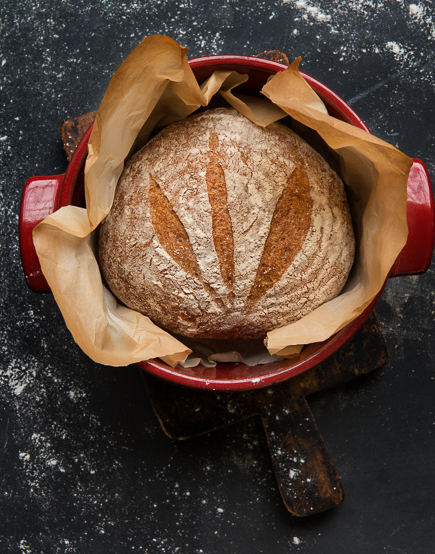
(The pictures in this post are by Stephen Scott Gross, who did the photography For New Healthy Bread in Five).
After writing the first edition of Artisan Bread in Five Minutes a Day in 2007 I was immediately asked how to convert the recipes to whole grains, and maybe even gluten-free equivalents. Through quite a lot of other adventures, the updated version has come out: The New Healthy Bread in Five Minutes a Day: Revised and Updated with New Recipes.
There are more photos to inspire you and make baking easier, all the recipes are in cup measures and weights, since we love baking with a scale and we’ve added charts for different kinds of flour, since there are so many on the market to choose from. And there’s a vast chapter of tips and techniques. Here’s a summary of what’s new in the new edition:
- Using sourdough starter as a leavening agent: for the first time in any of the books, instructions on creating your own starter and then using it as the leavening agent for homemade bread. Yeast bakers still have our original instructions as well.
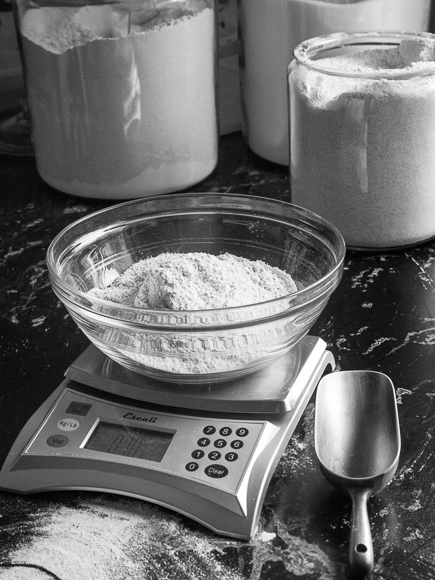
- Weight equivalents for every dough recipe. Weighing’s more accurate and it’s catching on in the U.S. We’ve really made leaps and strides as a baking country since 2007 (when the first book was launched), because inexpensive digital scales have become available everywhere.
- Versions and options for omitting vital wheat gluten: Some of our readers asked how they could omit this from the recipes in the original Healthy Bread in Five Minutes a Day—which all called for added gluten. I’ve done that for the Master Recipe, and given some rules of thumb for doing it for the rest of the book as well (it’s a water adjustment).
- Using offbeat or ancient grains like spelt, Kamut (khorasan), and sprouted wheat: New rules of thumb for water adjustment when you use alternatives to standard supermarket whole grain flours.
- Other new ingredients that have started appearing in American pantries: Coconut and flaxseed oils work great in the recipes calling for oil.
- A gluten-free chapter: It has all the favorites from the book’s first edition, based on positive feedback from readers.
Now let’s dive into our Master Recipe, which didn’t change much, because it works so well and it is a great place to start for people who aren’t used to baking with whole grains. With whole grain baking you need more water, and one extra ingredient called Vital Wheat Gluten (sometimes labeled “vital wheat gluten flour”), which is available in most supermarkets, or mail-order/on-line from anywhere…
Whole grains can make for a drier results; all that bran soaks up water. So we increased the water for all the new recipes. But that was only part of it. I found that boosting the gluten content with vital wheat gluten increased the amount of time we can store the dough. Storing the dough is why these recipes are different from all others and makes baking so fast. Vital wheat gluten makes whole grain dough springy enough to be stored in the refrigerator as a large batch. There’s also a version without vital wheat gluten in the book for those who prefer not to use it or can’t find it.
What is vital wheat gluten? It’s the protein-rich part of wheat that creates the strands that trap gas bubbles and allow yeasted bread to rise (and stay risen). It doesn’t take much vital wheat gluten to make a difference in a 4 to 5 pound batch of whole grain dough. Just 2 to 4 tablespoons are all you need, so while the whole bag or box may seem expensive, it doesn’t add much to the cost of baking.
So where do you get vital wheat gluten? Most supermarkets in larger towns and cities carry it. The two brands in U.S. supermarkets are Bob’s Red Mill and Hodgson Mill, and we tested those extensively. If your local store doesn’t carry vital wheat gluten, you can mail-order it from Amazon; click for either the Bob’s Red Mill product, or the Hodgson Mill product (you can also order directly from those company’s websites).
Master recipe from The New Healthy Bread in Five Minutes a Day:
There are many, many more details are in the book, along with plenty of recipes that are 100% whole grain; this recipe is about 73% whole grain:
Ingredients:
5 3/4 cups (750g) whole wheat flour – This is based on typical supermarket whole wheat, but we have a chart in the book so you can easily bake with King Arthur, Bob’s Red Mill, Sprouted Wheat, Kamut, Einkorn, Spelt or Hodgson Mill.
2 cups (300g) unbleached all-purpose flour
1 tablespoon (10g) granulated yeast – can decrease. You can use any kind of yeast including: instant, “quick,” rapid rise, bread machine, or active dry. You can also decrease the amount of yeast in the recipe by following the directions here. Or you can bake with a sour dough starter, see instructions here.)
1 tablespoon (15g) Kosher salt – can adjust to taste or health concerns
1/4 cup (40g) vital wheat gluten (or vital wheat gluten flour) – Here is a version without vital wheat gluten
4 cups (910g) lukewarm water (about 100°F)
1 to 2 tablespoons of whole seed mixture for sprinkling on top crust: sesame, flaxseed, caraway, raw sunflower, poppy, and or anise
To make the dough:
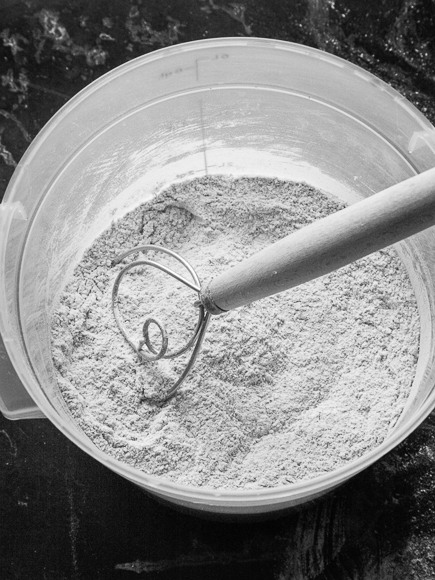
First, measure the dry ingredients into a 6-Quart Round Container or bowl, and whisk them together (you can also use a fork, or if it’s lidded, just shake them well). Mixing the dry ingredients first prevents the vital wheat gluten from forming clumps once liquids are added.
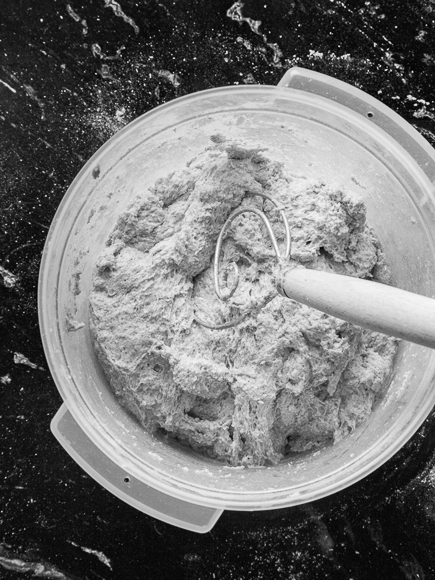
Add the water to form a wet dough and mix with a Danish Dough Whisk or wooden spoon.
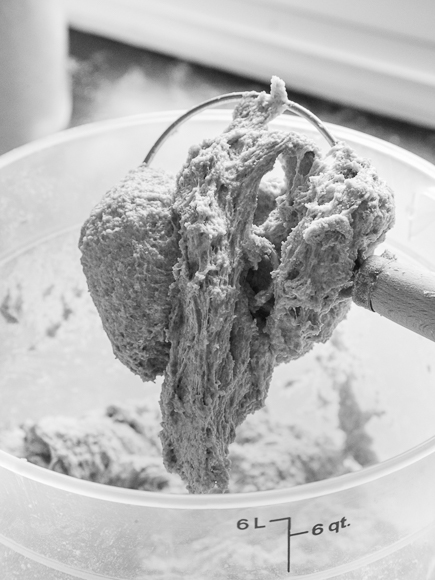
Don’t add additional flour to dry this out. It should be wet and shaggy.
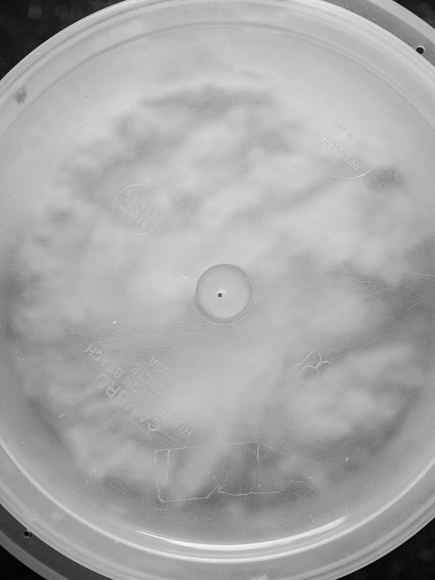
Cover loosely (leave lid open a crack) or you can piece a small hole in the lid, as you see above. Allow to rise for two hours at room temperature (if you decreased the yeast, you’ll need more time). NEVER PUNCH DOWN. The dough will rise and then begin to collapse. Refrigerate and use over the next 14 days, tearing off one-pound loaves as you need them.
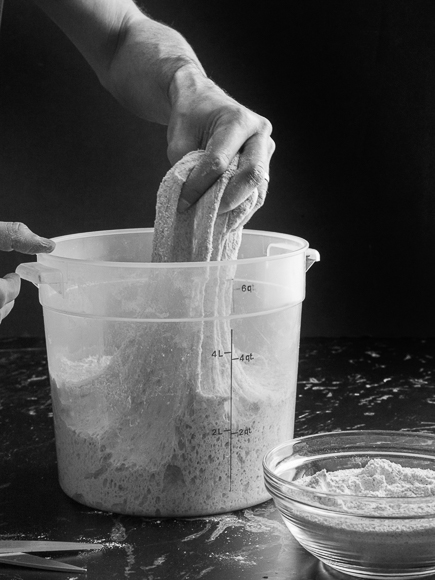
On baking day, cut off a grapefruit-sized piece of dough (about a pound), using a serrated knife or a Kitchen Shears.
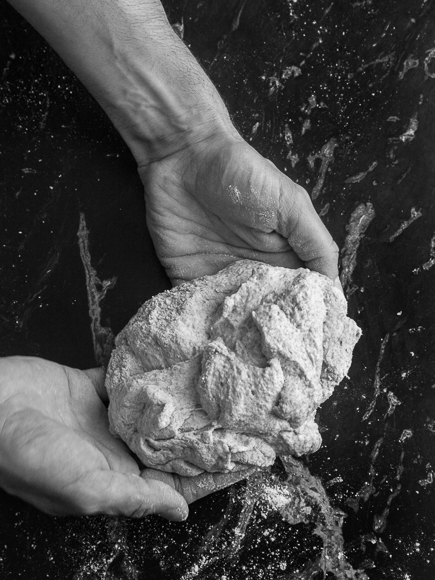
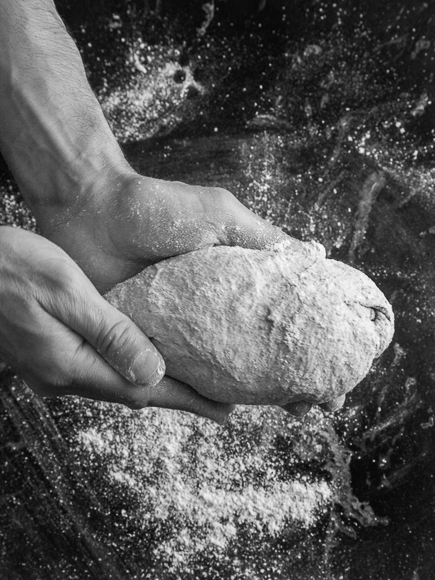
Quickly shape a loaf as you’ve seen in our videos on this website.
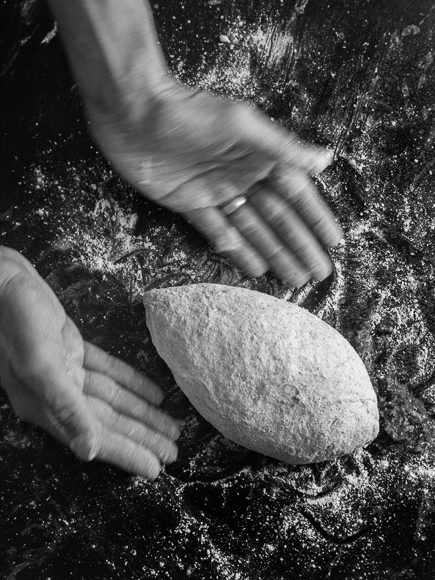
It should take less than a minute— you pull the top around to the bottom, rotating quarter-turns as you go. DON’T KNEAD or otherwise knock all the gas out of the loaf.
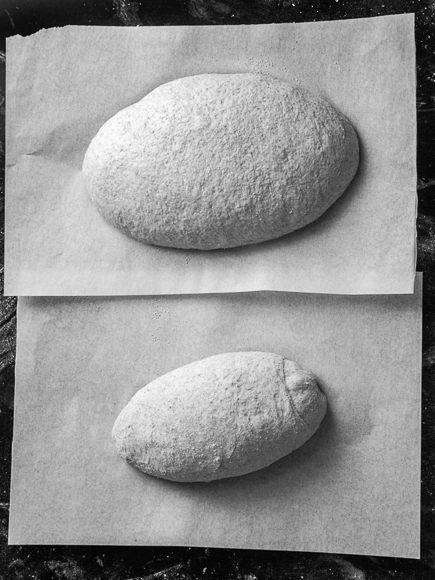
Cover the loaf loosely with plastic wrap and let it rest on a pizza peel covered with cornmeal or parchment for 90 minutes (40 minutes if you’re using fresh, unrefrigerated dough.) Depending on the age of the dough, you may not see much rise and it may spread out. The bottom loaf in the photo is just after shaping and then the one above it has rested and is ready for baking. Our loaves depend more on “oven spring” for rising.
Preheat the oven to 450°F (230 degrees C), with a baking stone placed on a middle rack. Place an empty broiler tray for holding water on any other rack that won’t interfere with rising bread.
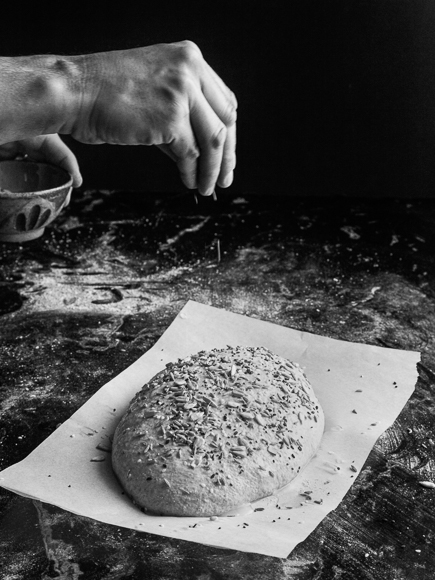
Just before baking, use a pastry brush to paint the top with water (we’ve dropped the cornstarch wash) and sprinkle with seed mixture.
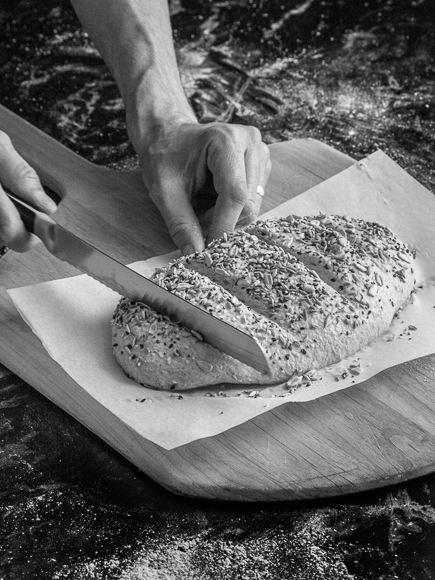
Slash the loaf with 1/2-inch deep parallel cuts across the top (or a singe lengthwise cut as in the first picture). Use a serrated bread knife held perpendicularly to the loaf:
Slide onto the hot stone…
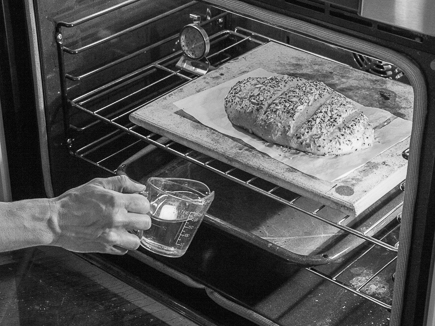
…and carefully pour 1 cup of hot tap water into the broiler tray (in the book, we give alternatives for creating that steam environment, which is essential for creating a great crust):
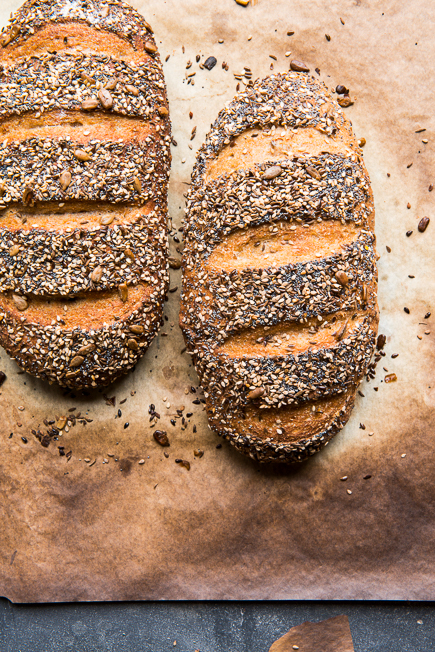
After a 30-minute bake, cool on a cooling rack.
Here are more shapes and ways to bake our Master recipe:
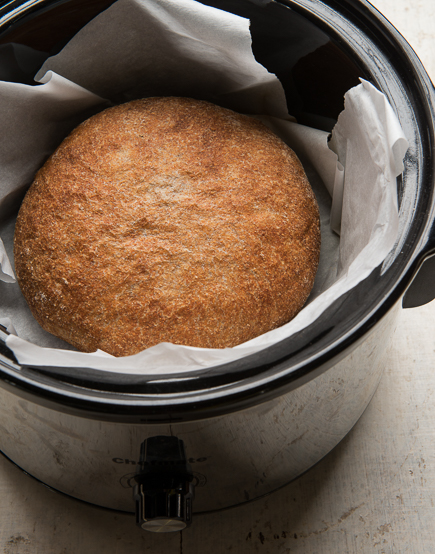
Slow Cooker bread from our Master recipe
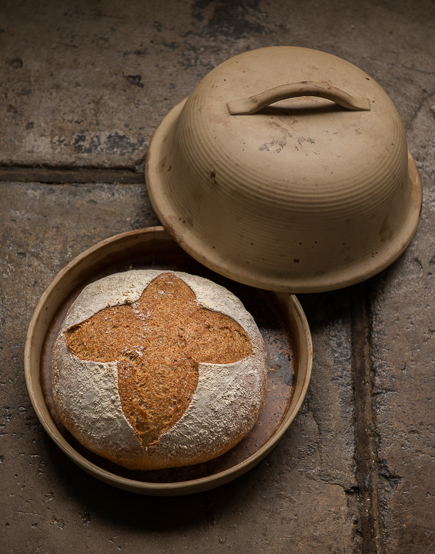
Master recipe baked in a Cloche
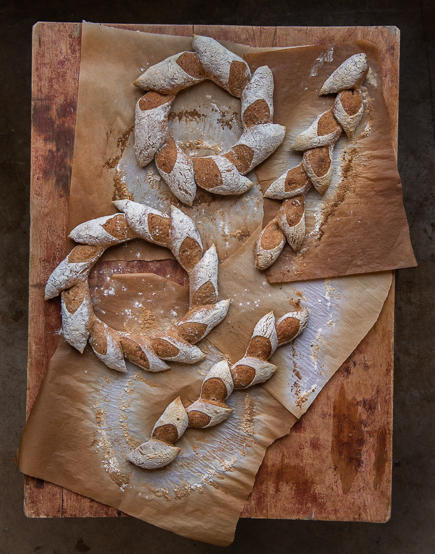
Epi and wreath from Master recipe
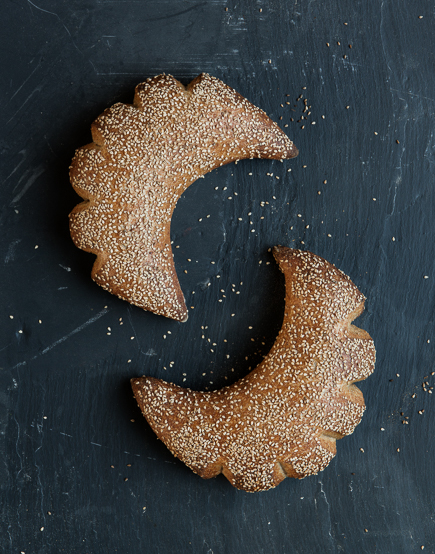
Moon and stars made from Master recipe. And there are many more in the book, plus 100 other recipes.
Note: BreadIn5.com is reader supported. When you buy through links on the site, BreadIn5 LLC earns commissions.
I love the breads in ABin5 and love HBin5. I bought 3 of the cookbooks as presents for Xmas.
Now that I have been making HB breads for a while, I miss some of the old AB breads. I miss the fluffy light texture.
I tried to make the Oat Flour bread and substituted 1 Cup of APF for 1 C of White WW flour and 1 Tbsp of VWG. The bread was pretty dense.
Is there a rule of thumb that I can use to swap some WW flour into the ABin5 recipes?
Thanks in advance!
Hi Scott,
There is no real rule of thumb, just trial and error. To get the lighter texture of the ABin5 breads you probably don’t want more than 50% whole grains. Once you go above 50% the texture of the breads is naturally denser. You will also want to keep the vital wheat gluten at a 1/4 cup even though you have more white flour.
Hope that helps and please let us know how it goes! Zoë
I made my first loaf for dinner tonight, it was delicious!!!! It was so good, I decided I would rather have a big slice of bread and a plain salad than the leftovers I had intended. It baked up beautifully in my 6 qt enamel cast iron pot, great crust and tender inside! The great thing about this method is I already have the dough to make a few more loaves. In fact I am going to a potluck luncheon tomorrow and may just make up another loaf for that. I can’t wait to get the book for Christmas! Thank you!!!
Hi Kathie,
Thank you for the lovely note, we are thrilled that you are enjoying the bread!
Cheers, Zoë
Haven’t purchased the “Healthy Bread in five Minutes a Day” yet but did copy the master recipe. Found the Vital Wheat Gluten at the Boise Co-op and purchased a package. Finished off my “Peasant” batch from you first book and while that baked I make a “new” batch of the whole wheat bread. After it rose for 2 hours I pulled off a grapefruit sized piece and made my first loaf. I thought the bread from you first book was to die for. “HOWEVER THIS LOAF TOPPED THAT. I still can’t believe how easy and fast it is to make delicious home baked bread from start to finish in about 80 to 90 minutes.
Thank you both for these delicious and healthy breads. If santa doesn’t leave me you new book, it will be my first purchase after Christmas.
Thank You Thank You!!!
Sue in Idaho
Sue, we loved reading your note, makes it all worth it. Come visit again anytime you have questions or problems. Jeff
Hi Jeff and Zoe,
I’m really impressed by the fabulous array of recipes in HB5!
However I haven’t been successful making the master recipe yet – when I make it the dough is really, really wet. No way I could form a free form loaf. I bake it in a tin but the crumb is sticky and gummy (my toddlers still love it though!).
So I’m guessing my dough is too wet.
I make it with freshly ground wheat flour which I weigh out. I weigh out the white flour too.
The white flour I use is 00 so very high gluten so in theory that should make the dough drier rather than wetter ???
The only other thing I can think of is the water. I use a measuring cup that says it holds 250ml. In HB5 it says 4 cups of water or 900g….am i putting too much water maybe? I thought 1000ml of water weighed 1000g but maybe my measuring cups are wrong? I’m in the UK so it may be that my measuring cups aren’t the right size.
Does any of your videos show what the dough should look like immediately after mixing?
Thank you for your time once again
Hi Magali,
The issue is with the type of flour you are using. The “00” flour is actually very low in protein and therefore you will have a wetter dough. It is wonderful for pasta and pizza, but doesn’t have enough structure for breads. You want to use a flour that is hard wheat and “00” is made from soft wheat. Our all-purpose is closer to “plain flour” in the UK.
Are you able to find the vital wheat gluten?
Thanks , Zoë
Thanks Zoe.
That explains it then!
When I visited my family some months ago in France I went to a health food shop that sold large packs of gluten. I only bought it bc I have searched for it in the past in the UK and not been successful.
At the time I didn’t know how happy I would be to have it in the pantry when I received your book!
Would the 00 flour work for your non-wholegrain recipes?
Thank you so much for all the help you give us – it makes such a difference.
Hi Magali,
The 00 flour is really too soft for loaf breads, but will make a nice pizza or flatbread. It may be a little sticky to handle, but with enough flour on your hands and the counter you can certainly do it. Our next book is about pizza and flatbreads and we will be developing a recipe using 00 flour. It doesn’t come out for nearly two years so you may want to do some experimenting on your own, or freeze that flour until 2011! 😉
So glad you were able to get the vital wheat gluten.
Cheers, Zoë
I tried my first five minute bread from your Healthy Bread Cookbook. The dough did not deflate after two hours. It was set near a wood stove so I am wondering if the temperature of the room is important. After refrigeration my dough came apart easily. I didn’t need to cut it. Any suggestions?
Can’t wait to try more recipes!
Hi Pen,
It is okay if the dough does not deflate after the 2 hours, just throw it in the refrigerator and it will continue to rise and do its thing. By the morning it will be all set to go.
The master recipe made with whole wheat is not quite as elastic as the one made with only all-purpose. Perhaps you should take a look at our videos and make sure that your dough is not too dry. If it looks much drier than ours you may need to add a touch more water next time. https://artisanbreadinfive.com/?page_id=63
Thanks, Zoë
I’ve been experimenting with whole wheat sourdough bread making for the last 2 years, and haven’t come up with a light airy loaf yet. The bread is delicious, but dense. Needless to say, I fell in love with your technique when I recently found your new book.
I use organic whole wheat bread flour and organic whole wheat white flour (instead of the all purpose flour) and sea salt, instead of the kosher salt. I buy it all, including the yeast and gluten in bulk at our local health food store. Since I don’t own a stone or pizza peel, I use a non-stick perforated pizza pan. I place the wet loaf directly on it (no parchment, corn meal or oil needed). I bake the bread on the middle oven shelf, on the perforated pan, using the broiler pan with hot water on the bottom shelf. I’ve gotten perfect results each time.
I will experiment by adding some of my sourdough starter to the basic recipe, to see if I can get that great San Francisco sourdough taste. Has anyone done this, yet?
Susan: Interesting experience you’ve had with this, terrific. For my experience with natural sourdoughs in this method, check out https://artisanbreadinfive.com/?p=1284. Jeff
I have to say how impressed I am that you’ve chosen to post your master boule and master wheat recipes online, which only cemented my decision to purchase both books, once my family gave me the thumbs up on taste. I am having a great time discovering all the things I can make, with the basics. Now to dive into the books and try some new recipes from them. Thanks so much!
Hi Debbie,
We are thrilled that you enjoyed the breads well enough to want the books. 🙂
Enjoy and Happy New Year! Zoë
Thanks. I think that is what I wanted. I’ll bake some and see.
On Page 64 of “Healthy Bread”…Whole Grain Garlic Knots, the recipe calls for 2 tablespoons of grated Parmigiano-Reggiano cheese.
I do not see where the cheese is used in the recipe…is it just added to to the top of the bread when it comes out of the oven? (I am sure it is there, I am probably misreading the recipe).
Really enjoy the new book, have made several of the recipes…easy and always delicious.
Thanks.
Keith: Sorry, should add “Sprinkle grated cheese over the knots” to Step 5. Jeff
Hi Zoe Jeff, just found your site and made my first artisan bread today I am a little dissapointed it didnt get brown and was a bit heavy, but I shall keep trying, I would love to buy your books but live in Margarita Island (Venezuela) and dont seem to be able to locate a bookstore here that stocks it either in Spanish (which I am not fluent in) or english And worse still we dont recieve mail here so I cannot order online great dissappointment , also with regard to vital wheat gluten I cannot find it here can I use any substitute for this if not I am lost please please help, I do make a lot of different breads with the old method but would love an easier life, keep up the good work, Marion
Hi Marion,
Are you trying the whole grain recipe or the one made with all-purpose flour? The whole grain recipe without the vital wheat gluten will certainly be a bit heavy. The vital wheat gluten allows it more stretch and a better rise.
What kind of flour are you using? Can you find a high protein bread flour?
Thanks for trying the breads! Zoë
Hi Zoe and Jeff,
I have both of your books and have loved everything I have made from them so far.
I was looking at trying the recipe for Banana Bread in your new book and noticed that it called for white whole wheat flour. Would a standard whole wheat flour work in the same amounts? I have limited storage at the moment and don’t really want to add a fourth type of flour to the cupboard.
Thanks for a great set of books and I look forward to the next one!
-drew-
Hi Drew,
It will work, but may have a stronger wheat flavor. This bread is not as sweet as the traditional “quick” banana bread, so you may want to add a couple more tablespoons of honey? Depends on your taste and how sweet your bananas are.
Thanks, Zoë
Thanks Zoë!
I’ll give it a try and see how it goes.
-drew-
Just started my first batch of the Healthy Bread master recipe. Can’t wait to bake a loaf. I don’t buy bread anymore. Love it !!!
I made the 10 grain bread from the December/January issue of Mother Earth news yesterday after searching high and low for “Vital Wheat Gluten” for several weeks. On Bob’s Red Mill’s website, it listed a lot of local grocery stores who were distributors but none of them carried this particular product. I finally found another brand (NOW Foods) in a local health food store which was called “Wheat Gluten Flour” but I wasn’t sure if this was what I was supposed to be using? While the bread had a wonderful flavor and nice, crunchy crust, and the dough did rise during the 2 hour rising period, when I baked it, it pretty much stayed the same shape and size as when I put it in the oven. Can anyone tell me what I did wrong??? This was my very first attempt at making bread at home so any advice would be greatly appreciated! Thank you! Nanette
Nanette: “Wheat Gluten Flour” is probably the right stuff. Did you do the full rise time we recommended (increase to 60-90 min if you went 40)? White or whole wheat in your recipe? Bleached or unbleached flour? Did you test your oven temp with a thermometer? Here’s one: https://www.amazon.com/Taylor-Gourmet-Thermometer-Stainless-Steel%252fCopper/dp/B000HB5NA4?&camp=212361&linkCode=wey&tag=arbrinfimiada-20&creative=380725
Hi! I made the master recipe for whole wheat bread. Thank you for posting it so we could try before buying. I have some concerns about the first loaves before making more. I checked the comments and answers on your site before writing but still have questions.
When I heard artisanal bread, I expected a browned, crackly, substantial crust with a caramelized taste and springy tasty interiors with medium-sized shiny holes like the whole grain artisanal hearth breads we buy at our bakeries.
What I got was bland, though salty enough, dull-colored, thin and soft crusted, small-holed, soft like a cake rather than springy–and it staled so quickly.
We used our co-op’s bulk organic whole wheat flour, which usually is from Vermont’s Lake Champlain area, or could be Arrowhead Mills, depending on the week. I used organic bread flour, which usually comes from Vermont as well, for which I added 2 T extra water, as we had no AP flour. Used Arrowhead Mills Vital Wheat Gluten and filtered water. We did the 2 hour rise. Dough doubled and then fell slightly. We aged the dough a few days in the fridge, shaped the loaves lightly, proofed for a good 120 minutes by our wood stove (our kitchen is very cold, and the first 30 minutes were in there). The dough spread slightly but did not rise noticeably when proofed, which is why we went to 2 hours with it. My oven is definitely working well. We used the preheated pizza stone, the broiler pan with hot water, brushed the crust with water. We got some oven rise on the loaves in that they rose at the bottom and sides, and the slashing marks spread out, but we wanted a more dramatic rise, more crust action, more spring to the crumb!
How should these whole grain loaves taste and feel?
Thanks so much,
Cindy
Cindy: Loaves high in whole grain are difficult to get a crackly crust because of the oil in wheat germ. I’ve had my best results with alternative steam methods, like these: https://artisanbreadinfive.com/?p=552, https://artisanbreadinfive.com/?p=566, or https://artisanbreadinfive.com/?p=510. See what you think of those. And I’d bet most of the artisan loaves in the store you reference are partly white flour, which it sounds like you don’t want to do.
About a zingier taste: store this dough for longer and you’ll be much happier with the taste. The loaves you make on day two don’t have much sourdough characteristic yet. Stagger your batches so you always have a four-day old batch to work with. At least that level of aging. Fermentation by-products also help prevent rapid staling.
But most importantly, you are using a 100% WW approach, so you should use a different recipe; see page 79 of the new book. What you did will yield too dry of a dough for our method to work well. And just to see how it’s supposed to come out, try a batch with commercial WW flour, that’s what we tested with because it’s what most of our readers will have. The result should be moister, have more flavor, and rise nicely. But expect less proofing-rise from our method, and proportionally more oven-spring. Jeff
When done with the right recipe and flour, I think you’ll find that the taste and feel
Jeff, thanks for writing so quickly and the reinforcement about less proofing rise, more oven spring. To clarify my muddled email: I made the breads with your white and wheat flour ratio of 1/3 white, 2/3 wheat, NOT 100% whole wheat. The dough was moist just as your photos illustrate. Also, the whole wheat was commercial, pre-ground–it is just from New England, if that makes a difference.
The second baking, when the dough was 5 days old instead of 3, is cooling on the counter right now and I’ll you all know how it came out! And I’ll try the all-white to see what those are like. Thanks for the tips on 100% whole wheat as I’ll try that another time.
I have to 2nd the suggestion posted someplace, especially for those mixing by hand, to mix up the dry ingredients in a bowl and then add that to the wet ingredients in the storage container.
I had another question though, especially about the master recipes. I often want to bake bread at the same time I’m cooking other items. Tips on this would be appreciated as it does change the moisture content…. and also I’d love to know suggestions for recipes that work best at 350 degrees. I don’t have a 2nd oven but I have been known too cook a few things in the toaster oven so I could reserve the oven to finish my breads, lol. THANKS!
Jessica: You can bake bread in the oven with other stuff, and the steam isn’t a problem. In fact, for our crisp-crusted breads, we ask you to bake with steam. Usually the steam dissipates in the first 10 minutes or so– this means that your crust may not firm up as nicely as you’d like, but it’s not a huge big deal.
All the sweet breads, and anything high in eggs (challah, brioche) bake at 350. You can bake lean breads @350 too, but they won’t develop a firm crust and will take longer to bake. J
Hi,
I’m writing to you from Australia. I have tried your white master recipe, which was great. My husband said it was the best bread I have made so far. Then I mixed up this ww master recipe and although I do keep it in a covered container (not sealed) in the fridge, I seem to have a little problem with the dough skinning. The first time I baked with this batch (it was roughly 24 hours old) I just ignored it and ended up with really dense areas where the skin ended up. in the loaf Seeing that you tuck it under while shaping, there was a dense “line” running through my loaf. But the taste was good and my husband loved it, too.
Now the dough is about a week old and has a bit of a sourdough smell to it, which I love. But the skin is even dryer. still relatively easy to form, though. I am giving it an overnight rest in the fridge now, covered with cling wrap.
I also found that the dough didn’t stretch like in your pictures but just sort of snapped off. I am using an organic ww flour. I havee never heard of white wholewheat. What is that???
The bread had a adequate crumb, wasn’t as dense as I had feared and great flavour.
Once I finish this lot of flour, I will purchase ww bread flour (strong flour). Do you think that will give me more stretch?
What temperature do you bake the bread to? I’m pretty hopeless with the knock and listen method, so I prefer using a thermometre.
I have ordered you new book and can’t wait for it to arrive. I really want my children growing up knowing bread is more than just the spongy stuff most people buy at the supermarket. I grew up in Germany where we were surrounded by a huge variety of what call “real bread”. I miss it. Well, i did until I started baking myself.
Thanks so much in advance.
Alex: Glad the bread’s working for you. Sounds like the dry environment of the fridge is getting to your stored dough. You can prevent this by limiting venting to the container– just a crack open the first 48 hours, then you can snap it shut. And if you transfer to smaller containers as you use it up, you minimize the “head space” and that should also help. If you really need to, drape a piece of plastic wrap over the dough surface and that should handle it.
About dough texture and consistency, sounds like the flours you’re getting absorb water differently from ours in the US and that can be a challenge. The AP we use is about 10% protein, see if you can match that. Otherwise look at our videos at https://artisanbreadinfive.com/?page_id=63 and adjust the water so the dough looks like that.
The white whole wheat discussion is on page 10 of the new book, also see https://www.kingarthurflour.com/shop/items/king-arthur-white-whole-wheat-flour-5-lb
Jeff
Hi,
1. Can I use whole wheat bread flour in the whole grain master recipe? If so, do I use the same amounts?
2. Do I need to bring refrigerated whole wheat flour to room temperature before I use it in a recipe?
Thank you.
Sandra: You may need a little more water; scale up the water so the result has the consistency you see in our videos, at https://artisanbreadinfive.com/?page_id=63. Assuming you are starting with lukewarm water, I don’t think it’s going to matter that you’re starting with cold flour. It may take a little longer to fully rise since the starting temperature is a touch low. Jeff
Thank you, this bread was really great!
Hi Jeff,
Thanks for your reply. I think the white flour I used had about 9% protein. Not sure about the ww. I will try and find one that is closer to 10%.
On an Australian web-store that I sometimes order flour from, they state that American flour is often blended with diastatic malt at the mill. This is not the case in Australia. Apparently this is why quite often American recipes don’t work with our flours. Should I add diastatic malt?
By the way, after I rested the loaf (made with the heavily skinned dough) in the fridge over night, covered with cling wrap, the bread turned out fantastic. The long rest must have somehow re-hydrated the dry areas. No dense line through the bread. And my husband loooved it (that’s saying something as he is a little reluctant to give up his white supermarket sandwich bread).
Thanks again.
Alex
Hi Alex,
How fascinating about the malt, do you remember where you read it? I’d love to see that. Adding a couple of tablespoons of the malt certainly won’t hurt and could be an interesting experiment.
I love the bread vs cheesecake description! LOL, Zoë
Thanks Jeff. I made a batch of the dough yesterday and baked a loaf of bread – delicious!
One more quick question – can the Whole Grain Master Recipe be used as pizza dough – if so, how long and what temperature to cook? Does the same method apply – how about baking in a cast-iron pan??? Thanks!
Sandra: Absolutely, all in the new book, same dough is great in pizza https://tinyurl.com/pe8yr9. I do my pizzas at 550 degrees F, for about 10 minutes (watch carefully if you’re not sure of oven temp). Pizza does well on a stone or on cast-iron. Or did you mean loaf breads inside cast iron pans, covered: https://artisanbreadinfive.com/?p=552
Zoe,
here are 2 links: https://www.basicingredients.com.au/brero.html
https://www.basicingredients.com.au/DiastaticMalt.html
Hi there! I’ve been LOVING the HBin5 book and have already made a few recipes. I’m trying out one from Artisan Bread tonight. I wanted to let you know, though, that I time lapse photographed some of the bread rising when I made the HB recipes. Not super high production value, but kind of fun to watch bread rise in 12 seconds. You can see the videos at: https://wp.me/pI6Ms-9M.
Thanks for an amazing book!
Beth: That was some fun cinema! Thanks for sharing it… Jeff
Love the new WW Master Recipe. I am adding 1 cup of Rye to get the taste I loved with the European Peasant Bread.
2 Questions.
1.) I am having problems with excessive spread in the rising. Leads to Flat bread. Is this too much water?
2.) Anybody know where I can find a non-stick “medium” bread loaf pan? Maybe 7 ‘ by 4″?
Thanks!!
Hi Scott,
Rye flour has very little gluten and so it is causing your bread to spread. You can try adding more Vital Wheat Gluten to the mix to give it more structure.
This is the only size I know of that is smaller than the standard 8 1/2 x 4″ loaf pan: https://www.amazon.com/Chicago-Metallic-Professional-Mini-Loaf/dp/B0000VLH06/ref=pd_bxgy_k_img_b
Thanks, Zoë
I made your bagel recipe using the maser recipe dough but had trouble with the raisins falling out. After you roll out the dough and put the cinnamon, sugar and raisins on it can you just roll it up and cook it like a loaf? How long should you cook it.
Thanks
Hi Bev,
Yes, it is wonderful to make it into raisin bread. Here is a post we did about that: https://artisanbreadinfive.com/?p=337 Let the dough rest for about 1 1/2 hours and bake it for about 45 minutes.
Thanks, Zoë
Should I cook it in a loaf pan or on the pizza wheel?
Bev: As in the post Zoe referenced, we did that one in a loaf pan, but it would work fine as a free form loaf on a pizza peel. Traditionally, it’s the loaf pan though. Either one’s going to be delicious. Jeff
Received ABin5 for Christmas and we haven’t bought a loaf of bread since – no kidding. It’s been an amazing journey. We will soon order your HBin5 book. Just tried the master recipe from this post last night but I didn’t refrigerate the dough before baking the loaf. What happened was that the loaf simply spread out on the parchment paper and didn’t rise in the oven. It still tasted good, but turned out more like a thick flat bread. Any suggestions for next time?
I suspect that it might have been too wet and that the flour needed more time to absorb the moisture to be able to hold shape. I did use appropriate flour, followed the directions, etc. I don’t imagine this recipe is meant for a loaf pan is it?
I imagine you have quite a following in Canada as well and I thought I’d point out that we have an amazing flour mill located in New Brunswick that ships across the country. Amazing products come out of this operation. I count my lucky stars that it’s located in my home province:
https://www.speervilleflourmill.ca/
Thanks for everything!
Amanda
Hi Amanda,
Yes, what you describe is pretty typical for dough that has not had an overnight in the refrigerator. Let me know if the dough keeps its shape better once it has been chilled for several hours. If not, then your dough may just be too wet and you will want to add a bit of flour to the mix.
Thank you and we’re so glad you are enjoying so much fresh bread! Zoë
I have just made my first wholemeal loaf. I used whey (leftover from making yoghurt), which I have done in the past with other bread recipes. I used the same volume of whey as the recipe said for water. The bread is delicious and has a great crust but is very dense. It had risen a lot in the fridge, but didn’t rise before or during baking. I am keen to continue to use whey and wonder if I should add more yeast? or do you have another suggestion?
Nicola: I’m guessing that more yeast will not solve the problem; you are getting a good intial rise. I haven’t tried baking with whey, so I can’ t say for certain… but, if you’re water-based breads in similar recipes are fine, then the whey is the problem. If so, could try cutting down to a mixture of whey and water and see how that does.
Also, take a look at the dense bread FAQ on that tab, above. Jeff
Jeff and Zoe:
Great job with your three books – I just stumbled across your website while surfing for cool tools. I have a question: What is the nutritional information for a 1lb loaf of bread?
Thanks!
Al: We don’t have formal nutrition calculations, but check the FAQs page (above) for a roundabout way to get to it. Jeff
Hi, it’s me again. I just wanted to let you know that I never had that skinning problem on the refrigerated dough again. I have made it twice since and it was fine for up to 2 weeks.
I have also finally received my HBin5 book. The vendor had accidentally sent me a book about cupcakes instead – not so healthy 😉 Well, they let me keep it and sent the HBin5, so now I have both. Not that I should be eating any cupcakes, trying to lose the baby fat… Anyway, I now realise I probably should have bought your ABin5 instead or both as I love the idea of European peasant bread… Might have to order that one. I believe it has a few rye recipes in it? I loooove rye breads (grew up in southern Germany where rye sourdough is very common. Not sure if you have heard of Pfister bread (Hofpfisterei), but it is divine, relativley fine crumb, moist but not too heavy).
Anyway, I just wanted to let you know that I’m looking forward to trying some of the recipes in your book when I get back from my German holiday where I’m going to stuff myself with rye bread and pretzels (I come from the pretzel capital of Stuttgart). I haven’t bought a loaf of bread all year 🙂
The only downside is that with such a relatively large batch, I have to wait too long before I can try out a new recipe, so I’ve been halving your recipes.
Oh, one thing about HBin5, I would have loved to see more pictures. Especially pictures of the bread sliced open to see the crumb to help me decide on which recipe to try and so i can see what I’m shooting for. But fortunately you have lots of photos on this website.
Alex: Others have mentioned about the photos. Our publisher sets the limit on photos, and though there are twice as many in HBin5, people have asked for more. Which is why there are hundreds on this website.
The other thing is that the website allows us to do video, which we’ve just started to do (see https://artisanbreadinfive.com/?p=1632).
So proud that you’re liking our stuff– Germany has about the best in the world, especially the whole-grain stuff. Thanks, Alex.
Jeff
hi jeff and zoe! i tried the master recipe last week (just got the book) and i loved it. i made the whole wheat master recipe 2 days ago and i just went to pull the dough out to make tonight. my dough is definitely not stretchy. when i pulled some out, it came out in a big clump…so sad. any idea what i’m doing wrong? the dough had a really nice rise out on the counter and i can see lots of holes through the side of the bowl. i used the scoop and sweep method (arrowhead mills organic ww flour and king arthur unbleached white flour). everything seemed to go fine until there was no stretchiness! how can i fix that? do i need to fix that? thanks!
Hi Elana,
Does your dough seem like it is drier than what we should in the videos? If so, you can add more water and let it sit for a while while the flour absorbs the additional water. I think that will result in a dough with more stretch.
If your dough seems wet, but just doesn’t have the stretch then maybe you need to add more vital wheat gluten to the next batch of dough. The Arrowhead Mill flour is ground more coarsely than many other brands and therefore doesn’t produce the same gluten strength.
I hope that helps. Thanks, Zoë
thanks, zoe! it seems a little drier but definitely less stretchy. i’m baking a batch now so i guess we’ll see! where would the baked difference be…the taste, the texture or something else?
if it’s just dry, can i add some water now even though i made the dough a couple of days ago?
Elana: You may be able to get away with that, worth a try. Generally, we try not to handle the dough much once it’s aged a bit; you can knock the gas out and end up with something dense.
Another approach I’ve used is to float some water on the surface and wait for it to absorb, usually over 12 to 24 hours. This has sometimes worked, sometimes not. Jeff
thanks jeff. it must have come out okay since we finished the loaf!
my whole wheat dough is definitely significantly less sticky than the dough i made with the original master recipe (that was too sticky, i think). it was much easier to shape and spread out a lot less. do you think i should still add more water when i make the recipe the next time? it’s hard to tell if my original recipe was too sticky and this one was too dry or if this one was right!
Hi Elana,
If you loved the bread and it was nice to work with I’d leave it alone. If you think it was a touch dry or dense then perhaps add a little bit more water.
Thanks, Zoë
Since people are asking for nutrition info and I was curious myself, I went ahead and figured out what the data was for this recipe. I’m counting it as 32 slices of bread in the entire recipe, and this is per slice:
102 calories
0.5 g fat
0g saturated fat
0g trans fat
220mg sodium
19g total carbohydrate
2.5g dietary fiber
0g sugars
5g protein
vitamin A 0% vitamin C 0%
calcium 1% iron 7%
Hope this is useful to you all!
Adriana
Re: Adriana’s post. We haven’t checked the math here, so can’t vouch for these numbers. Can also use the USDA tool you’ll find through our FAQs page. Jeff
wasn’t sure where to ask this, but i just finally read through your first book and i had a question (by the way, thank you for answering all my questions!) about the 100% whole wheat sandwich bread: i have a 4 year old who is allergic to milk. any thoughts on whether i can substitute rice milk for regular milk in the recipe? do you just heat the milk on the stove to warm it up?
last general question: i’ve been using parchment paper in place of cornmeal on the master recipe. can i use parchment paper in place of cornmeal or flour in all the recipes in the book?
Elana: In general, our recipes are very forgiving when you swap one liquid for another. I can’t think of any reason why this won’t work, unless rice milk develops off-flavors when baked into food. You’ll have to experiment.
Parchment paper can be used anywhere cornmeal or flour lining is used, yes. Jeff
This is a great new experiment that I am trying here at 1:35am! (I’m a 3rd shift paramedic – on days off, all I do is bake through the night!)
I just made the ww master recipe – I’ve been searching and searching for a good ww recipe.
Bread is becoming my new frontier for baking – not too familiar with it yet to play around with recipes, just trying to find a few good, solid base recipes to branch out from, ya know?
Just one question:
Is there a minimum amount of time that I should refridgerate this batch before I bake my first loaf with it?
Thanks in advance,
Ashley
Hi Ashley,
You sound like Jeff and how he got started with this whole bread baking endeavor!
I’d allow the dough to chill for at least 3-5 hours before using it. This will allow it to firm up enough to make handling it easier. If it is flavor you are going for then let it sit for at least 24 hours to allow some fermentation to happen.
Thanks! Zoë
I have two questions:
– I’m trying to make a cranberry pecan multigrain bread like the one Chabaso Bakery sells (https://www.chabaso.com/index.php?page=cranberry-pecan-multi-grain). Which one of your recipes would work the closest (I just bought your Healthy Bread book)?
– I was going to try the Oatmeal Date & Walnut recipe and was wondering whether that recipe would work if backed free form rather than a loaf pan?
Thanks,
Anke
Anke: Oatmeal Date/Raisin can certainly be baked freeform and that would be close to what you’re looking for. But it has oatmeal in it. Whatever you do from HBin5, it’s going to have more whole grain in it than what I’m seeing at that website– bet that’s mostly white flour by the look of it.
So expect a different result, though delicious. Jeff
Just last week, looking for a bread recipe, I came across your videos on Youtube, then found your website.
Made my first batch of dough and have baked several loaves. Oh, this is GOOD STUFF!
Definitely have to buy the Healthy version book as I do mill my own grains.
Jill
Jill: Be sure to read about my experience with fresh-milled wheat, look under our FAQs tab. Note that in the case of the stuff I used (someone else freshly milled it for me), it measured and baked up just like commercial whole wheat. Other readers have written in to say that coarser-ground WW doesn’t behave that way and they needed to adjust the water based on the appearance of the dough. See our videos to see how wet/dry the dough should look, and check back with us if you have trouble.
Bottom line– commercial flours, uniformly ground, work more predictably because they’re always the same. Not so for fresh-ground stuff. But I did think it was delicious. Jeff
Zoe,
You may want to revise your comment to Ashley on Feb. 28, 2010. I have enjoyed reading the posts and appreciate the laugh:)
OMG Proof Reader,
My only hope is that you got to that before Ashley, otherwise she may never come back!? That will make me laugh for a very long time! 😉 The problem with answering questions late at night!
Thank you, thank you, thank you! Zoë
Hi, just found your website today and baked my first loaf!
The taste and texture were wonderful, though it didn’t rise much during baking (my fault, I forgot to dust my hands when tearing off a chunk, forgot to dust the plastic during the last rising, and didn’t have a serrated knife).
I baked it in my dutch oven : 15 min @ 500F (covered) + 10 min @ 450 (uncovered), and it was perfect.
After reading through all (well, most) of these comments, I don’t recall anybody asking what is the best way to store the baked bread?
Thanks for sharing this technique and recipe… off I go to buy the book!
Hi Jenn,
Wow, you found us today and already baked a loaf! That is fantastic.
We generally suggest just placing the cut side of the loaf down on the cutting board and not covering it. This will prevent the crust from getting soggy. The loaf will last about 24 hours this way, some say longer!
Thanks, Zoë
I made your artisan whole wheat sandwich bread and it didn’t rise, and is hard. What did I do wrong?
Thanks
Kris: We need more information— which book are you working from, there are whole grain sandwich breads in both? Did you use vital wheat gluten? Common problems can be found by clicking on our FAQs page above. Typical problems:
1. Are you using the wrong measuring method? Must use scoop and sweep (not spoon-and-sweep).
2. You have to use unbleached all-purpose flour where white flour is called for (not bleached)
3. Consider a longer rest time, first book specifies shorter times than 2nd and many people prefer the longer rest time
Jeff
Hello,
I tried this recipe and followed the instructions precisely, but must add that I am not sure what you mean by vital wheat gluten. I did use wheat gluten. I couldn’t find any labelled “vital.”
It didn’t turn out very well at all. The yeast was active, but perhaps the climate here in the Pacific Northwest is too cool and humid for a 2 hr rise? Should I try it with an overnight rise instead? I was left with gloop that did not spring at all in the oven.
I should also add I have had success with the standard white flour recipe, but the housemate prefers wholegrain, and really it is better for you….
Any advice? I did use unbleached organic white and fresh organic whole wheat flours. The yeast is good, I used the scoop and sweep. Thanks for your time!
Hi MousE,
I think the issue is the fresh ground flour that you are using. It is tasty wonderful stuff, but tends to be a coarser grind and therefore behaves differently in our recipes. Some people who are baking with this type of flour have had better success when they added a couple of extra tablespoons of wheat gluten flour.
I hope this helps! Enjoy, Zoë
thank you for responding, Zoe. I have mixed up another batch, altering it very slightly – 5 cups ww and 2 1/2 cups unbleached, and added the extra gluten as you suggested. It did mix drier, and looks more like the pcture above. I’m going to let it sit out overnight, as it is cool and damp here, and will refrdgerate it for the day tomorrow. Will let you know how it goes! Thanks again, great book BTW.
Great Mouse,
Keep us posted!
Thanks, Zoë
Well, I am very disappointed, again it took forever to double in size – more than 10 hrs -and I tested the yeast first – and no oven spring at all. I ended up with a very flat loaf that was too yeasty and too salty; neither of us liked it… As I said, I know the unbleached flour I am using is fine as I have had good results before making the white artisan bread. And I made banana bread with the whole wheat flour, and it was heavy but fine with a good rise. For some reason I just can’t get this to work at all. Suggestions? I really appreciate it!
Hi MousE,
All of our recipes are tested with Gold Medal flour and I would recommend you try a batch with that flour and see if you are still having issues.
Thank you, Zoë
ps
It must be the whole wheat flour I am using; have whole wheate Red Fife. Is it just too hard a flour? Is there a specific type of whole wheat I should use?
I will see if I can find some. Thanks very much!