… it all started with a question for Lynne Rossetto Kasper on The Splendid Table NPR radio show, on April 4, 2000 (see video below), and then a publisher heard the call-in interview and made an offer.
I can’t vouch for this as a way of getting a cookbook idea noticed– it was a bit of dumb luck:
In case you have one of our lean doughs in the fridge (no enrichment or sweetener), but you want to bake up a morning bread or other sweet buttery thing, hope is not lost. I started with our basic light whole wheat recipe, and rolled some delicious things into it.
More about rolling in the fruit, brown sugar, and butter…
If you don’t find the answer to your bread questions on the Frequently Asked Questions (FAQs) tab, we encourage you to post into any of our “Comments” fields by clicking on the line that says “Leave a Comment” or “X Comments” just under the date of each post.
But please remember, our blog/website is moderated. That means that your comment doesn’t appear on our website until it has been approved, especially if you’ve never posted to our site before. That could take up to 24 hours. Here are some guidelines for comments that we are not willing to approve for our site:
References to commercial sites or endorsements for products, especially if the Authors haven’t used or otherwise can’t vouch for the product. In particular, our webmaster has asked that we not have visitors put website addresses (URLs) into our site, so we take those down. The converse is also true– if you say that you dislike a product, we may remove or edit your comment unless we’ve had the same experience with it.
Website URLs: Please don’t direct people to your own site. We reserve the right to remove any URL from comments.
Health claims: The science behind health claims made by products and about ingredients is often murky and controversial. We’re happy to answer questions about the health of ingredients or techniques in our books, but please don’t make complex health claims here on the website–in particular, claims about weight loss or disease prevention/control related to food ingredients. Like product endorsements, we’re likely to remove those kinds of comments.
Incorrect material: If you post instructions or tips about baking that we know are wrong or won’t work well with our method, we reserve the right to take them down or not approve them in the first place. Our site serves as an information source for bakers and we have to be careful about recommendations that appear.
Offensive or rude remarks: Usual manners apply! (Thank you)
Pingbacks: Please don’t set up your own blog to insert Pingbacks into our site.
Pretty much everything else is fair game. One other thing— very rarely, we simply miss someone’s comment. It’s just an oversight; if we haven’t answered you within 48 hours and you met the guidelines above, please “comment” again.
Note: BreadIn5.com is reader supported. When you buy through links on the site, BreadIn5 LLC earns commissions.
In the video above, I’m not entirely clear on baking times. You bake with the lid on the pot for the first two-thirds of baking, then remove it so the top crust can complete its browning for the last third of baking. If the loaf takes 30 minutes, then the first 20 are covered. Play with your grill to get the temperature stabilized around the level called for in our recipe (you need a grill with a thermometer), but be aware that you may need a lower temp than what’s called for– in some gas grills the bottom will scorch at full temp.
If you don’t have a cast-iron pot, you can use any oven-proof lidded vessel, including a cloche, but simple inexpensive things work as well. For cast-iron, you can use an enameled pot as in this post, or simple un-enameled black cast-iron.
If you do go for the Le Creuset enameled cast-iron pans (here’s a two-quart version on Amazon), they’re terrific, but you might need to replace the standard composite lid-knob with this metal one for high-heat baking, on the grill or otherwise. The composite degrades at temperatures above 375F or so, though some seem to say otherwise in the product literature. Check with the company if you’re in doubt.
If you use the 1-quart pan, that’s about exactly right for a 1-pound loaf, and will contain sideways spread. But… larger pans also work beautifully– the pan will be larger than the loaf and won’t contain sideways spread. You’ll see what I mean…
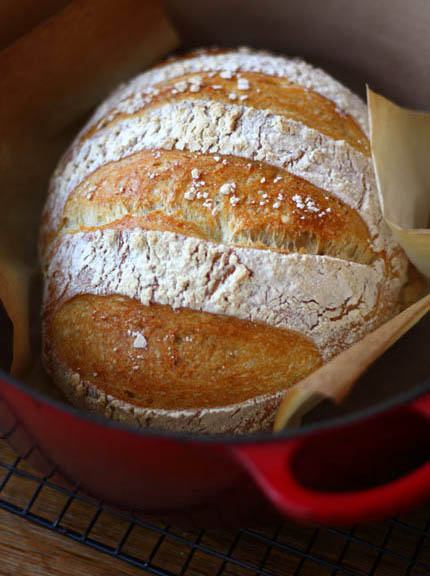
But here’s what the final result looks like (yes I’ve switched pots on you here, this is from a different baking session–the slashing on this loaf was parallel cuts rather than the cross I did in the video):
When we talk with people with a loaf-center that won’t bake through, it’s almost always one of these explanations:
The oven temperature is off: Usually it’s running too hot, and the outside looks brown before the center is baked through. But a low oven temperature can fool you too– you think you’ve baked long enough, but it’s actually running 50 degrees too cool. Home ovens can be off by 50 to 75 degrees F, so check with an inexpensive oven thermometer like this one on Amazon.
Inadequate oven and stone pre-heat: This can be an issue for really large ovens and thick baking stones. Some professional-style ovens (Wolf and Viking, for example) may need up to an hour of pre-heating. If you are using a thick baking stone, it may also need up to an hour of pre-heat. Even thin stones will benefit from a longer preheat.
Measuring flour incorrectly: The most common mistake is that someone isn’t measuring the way we describe in our books. We use the standard scoop-and-sweep method. See our video on this for proper technique. Do not spoon the flour into the measuring cup before sweeping– if you do, the cup will be too-lightly filled, and the dough will be too wet, leaving you with a center that won’t bake through. Consider weighing flour if you want to get away from the uncertainty of volume measurement, see the post…
If you’re really struggling with underbaking, you can try an instant-read thermometer. For lean breads (no eggs), the temperature at the center of the loaf should be 205 to 210 degrees F (96 to 99 degrees Celsius). For egg-enriched doughs, the temperature should be about 185 degrees F (85 degrees Celsius).
One other thing– thanks for a great review of Healthy Bread in Five Minutes a Day on Mary Hunt’s EverydayCheapskate.com, click to view.
After mixing the dough, our recipes only require two hours at room temperature for their initial rise (assuming you’ve used lukewarm water); then the container goes into the refrigerator where it can be stored for up to two weeks (depending on the recipe). According to the U.S. Department of Agriculture, the answer to this question depends on whether or not there were eggs in the recipe. Their website says that eggs should be refrigerated after two hours at room temperature (see their website, scroll down to relevant section).
For our doughs without eggs, when we’ve occasionally forgotten a batch and left it on the counter overnight, we’ve found that this has little effect on the final result, maybe just shortens the batch life by a day or two. If you find that you aren’t getting enough rise in two hours for non-egg dough rising at room temperature, you can go longer.
So, what would USDA recommend if you’re doing a long rise with dough containing eggs? Sounds like the first two hours are safe at room temperature, then into the refrigerator to complete the rising. We leave it to our readers to decide about how to handle egg doughs in light of USDA’s recommendation.
This weekend I over did it. Not with buckets of dough, but in my garden. I am determined to recreate the organic urban farm I had last year, but this time I am doing it without the aid of a professional farmer. Just me, a bunch of compost/manure and my dad, who happens to be a long time green thumb. I spent 12 hours prepping the beds and getting in some seeds. At the end of the day my right hand (the hand I write with) was so swollen I couldn’t move my fingers, tendonitis. The Dr. says not to use it for 2 weeks ~ 2 WEEKS! (I am typing this with one hand.) In order to do this post I enlisted my friend Jen to help make a Danish Braid. She is a great sport and it turns out quite skilled at modeling/braiding/baking.
The braid is made with the Brioche from ABin5, but you can do this same thing with any of the enriched doughs from that book or HBin5. We’ve done this same technique with savory fillings, so let your imagination go wild and let us know what you come up with.
When people write to tell me that their dough seems “too wet,” the first question I ask is: how are you measuring? Because I measured with the “scoop-and-sweep” method, not the “spoon-and-sweep” method.–view the video to see exactly how I do it.
American recipes usually are based on volumes, measured with standardized measuring cups. If you press down into the flour bin (use a flour bin, not the flour’s bag), you’ll compress and get too much flour. If you use the “spoon-and-sweep” method, where a spoon is used to gently fill the measuring cup before sweeping, you’ll get too little flour into the cup. Likewise, don’t “aerate” the flour by mixing it or whisking before measuring; that will lighten the cup.
If you do it the way I tested it (and use flours like the standard ones I tested with), you’ll get results like you see in our photos and videos. You can also consider weighing flour, using the weight equivalents that appear in all our books starting in 2009. There’s more about using weighing flour in this post; I use this scale.
Side issue: ignore what I said in the video (made some years ago) about bleached flour absorbing less water than unbleached–it’s not true anymore. Modern bleaching doesn’t include anything that decreases protein content. I prefer unbleached flour just to avoid the chemicals and because I love the richer color of the crumb that you get with unbleached, but it won’t affect the measuring or the ability to absorb water.
Note: BreadIn5.com is reader supported. When you buy through links on the site, BreadIn5 LLC earns commissions.
People sometimes ask us for simple formulas for converting traditional bread recipes to our stored-dough method. Unfortunately, there’s no simple answer to the question. Developing recipes for our books takes lots (and lots) of trial and error.
If we put our our testing methods and approaches up here on the web, our publisher would kill us! If you want to try to convert a traditional recipe to our high-moisture, stored-dough method, read through our books or check out our recipes here on the website to get a sense of the moisture level that’s needed, then check out the rest of the FAQs here on the website. Pay attention to our “videos” tab as well. It may take a bit of work, but you should be able to transform your existing repertoire.