Lemon-Poppyseed Mini-Brioches (with a couple of healthy tweaks)
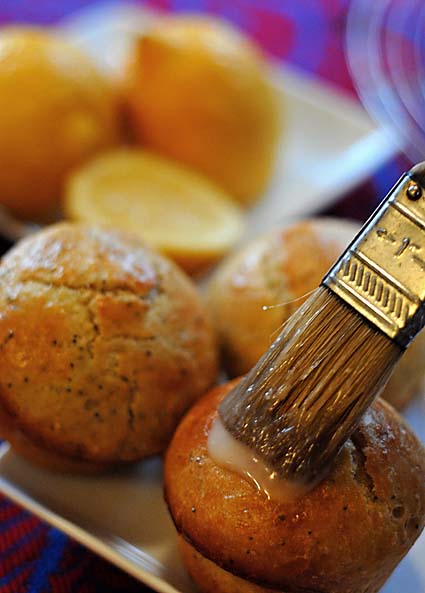
4-paint-with-glaze.jpg

On Mondays, it’s my turn to pick up my older daughter from school, and then stop for tea and treats before her guitar lesson.  We’ve been doing this for six years, and I think I love the tradition as much as she does.  Our downtown coffee shop has great coffee and tea, but the baked goods leave a lot to be desired, especially by the time we roll in at 4:00pm.  There’s one exception– they have a lemon-poppyseed pound cake that is just terrific (or it would be, if it were fresh!).  I wondered if we could adapt the brioche from Artisan Bread in Five Minutes a Day to the bright fresh flavor of lemon and the crunchy texture of poppyseed, topped with a simple glaze.  They baked up perfectly in cupcake tins so if you’re inclined to call these cupcakes, go right ahead.  And I snuck in two healthy tweaks to the recipe:  canola oil instead of butter, and even a little whole grain.  Read More
Baking Bread in a Closed Clay Pot (“Cloche”)– the best crust yet!

cover-cloche-baked-boule.jpg

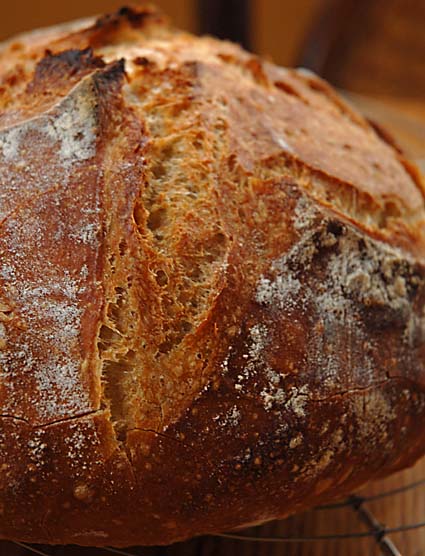
So many people have asked about baking dough inside a closed cast-iron pan (see a post on that). The cast-iron pan method is based on a much older method, where bread is baked inside a closed clay pot (or “cloche,” meaning “bell” in French).  Both methods depend on trapped steam from the dough to create a perfect crust, but the clay pot has the added benefit of being porous, so moisture is trapped, but also conducted away from the surface as the bread bakes.  I tested the Sassafras brand “La Cloche” product, and I’m very impressed with the crust I’m getting –take a look at the picture above; this crust is thin and shatters when broken (the burned bits are perfect in artisan loaves; that’s how you know you’ve baked long enough).  Keep in mind that these crust results are hard to re-create with loaves very high in whole wheat (because of oils in the wheat’s germ).  The bread above is about 15% whole grains– it’s a light version of the Peasant Loaf on page 46 of the book.  Whole grain breads perform beautifully in “La Cloche,” but the crust tends to be softer and thicker.

For crust aficionados, I think the “La Cloche” results are a little better than what I get inside closed cast-iron.  I didn’t put these two methods in our first book, because we wanted to keep things as simple as possible.  But with results like these, they’re going into he second one (publication date is 10/13/09)! Read More

Kaiser Roll answers…

Well, we had over 90 responses, and they fell into four categories:

1.  Buy yourself a “Kaiser Stamp,” which imprints the tops of round rolls with the Kaiser pattern.

2.  “Klopping,” the traditional method of folding and pressing (“klopping” refers to the karate-chop like action to make the seal).  Very difficult to achieve with our wet dough; I still haven’t managed a credible one.

3.  Grouping small balls of dough together.  Not really a Kaiser effect, but a great result.

4.  Knotting a rope of dough.  Really more of a “garlic knot” idea (see https://artisanbreadinfive.com/?p=202)

Who Can Fix My Kaiser Rolls?

kaisers-cover.jpg

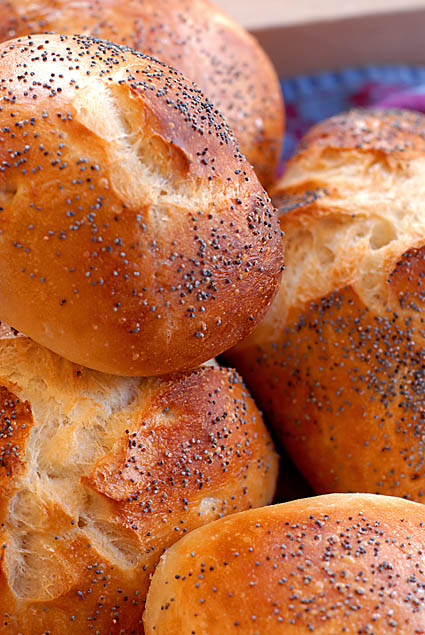
OK, I’m pretty happy with this photo, but… well, they aren’t really Kaiser Rolls.  I was on a “roll” from last week (sorry), when I thought my Brotchen were more than passable.  So I wanted to re-create another German roll style– the famous 5-petal Kaiser roll.  I have to say that even though the picture is pretty, the rolls didn’t retain the 5-petal shape that defines the Kaiser roll– it ended up as just a round, though beautiful and tasty roll.

And so fellow bakers, I turn to you for help!  What did I do wrong?  Please make suggestions that help me perfect this beast… Read More

German-Style Rolls: Brotchen (the crusty secret is an egg white glaze)

cover-brotchen.jpg

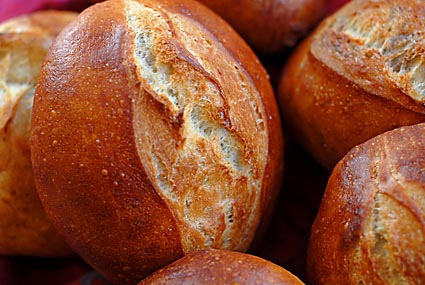
Many people have been writing to ask for German-style hard rolls.  The most common are Brotchen (little breads). They’re made from egg white-enriched white dough, and brushed with more egg white before baking at high temperature with steam. In the book, I concentrated on French-style crust techniques, which tend not to use egg white for high-temperature crisp crusts on lean breads. Turns out that the egg white creates an incredible crust and crumb.  Read More

The Easiest and Tastiest Homemade English Muffins!

english muffins

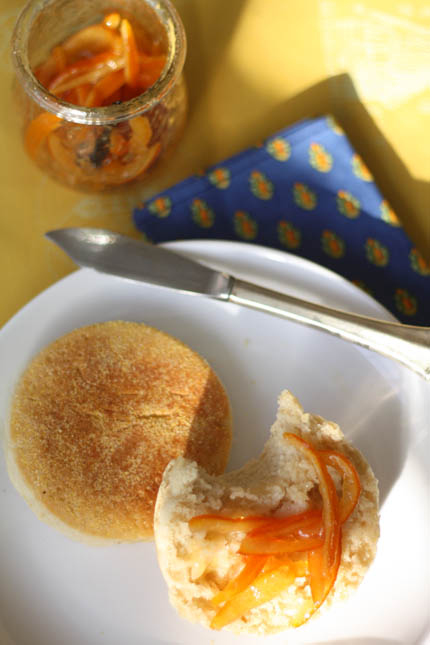
In case some of you have missed the memo, it is BYOB year! Bake Your Own Bread!! There are several food bloggers whose New Year’s Resolution is to bake all the bread they need and never buy a single loaf (see below for info!). This includes artisan boules, sandwich breads, sticky buns and even English muffins! These most popular breakfast muffins are a favorite in my house and yet I never make them. There are some things I perceive to be too much trouble to bake at home and shamefully never tried. The English muffin was among them. Oooops, I discovered today that they are so simple and really fast! I owe my family a big apology for not having tried this earlier. I have several of you to thank for this lovely discovery. The English muffin has been a most requested item lately and so here it is in all its simple glory: Read More

Homemade Soft Pretzels!

pretzels-cover.jpg

Food writing can be very, very memorable.  In 1978, I read a marvelous essay in the New York Times by Mimi Sheraton.  They say that tastes and smells are the most memorable senses, which explains why when we re-create food we ate as children the smells bring us back in the blink of an eye.  The same’s true of great food writing, at least for me.

Mimi’s article on homemade pretzels she ate in Stuttgart, Germany is one of those great food articles that stayed with me.  I clipped the article and forgot all about it.

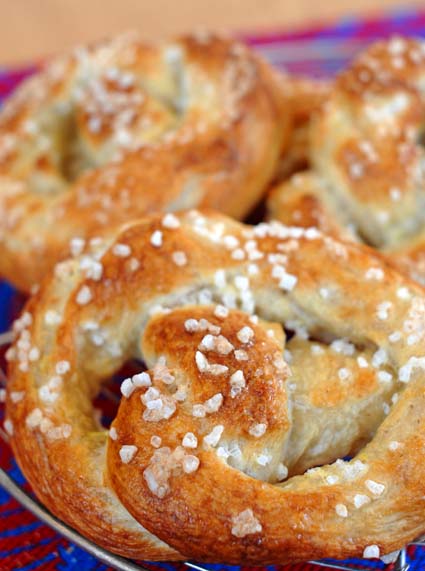
Testing recipes for Artisan Bread in Five Minutes a Day (click here to purchase), I finally made Mimi’s recipe, adapted from her Stuttgart hosts, so I adapted it for Artisan Bread (page 127 in the book). Read More

Chocolate-filled Beignets (or Soufganiyot, or whatever you’d like to call them)

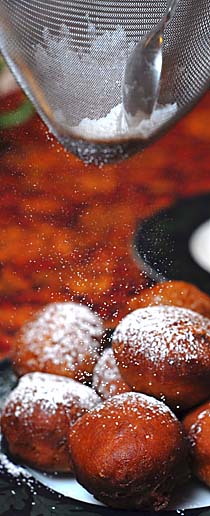
sugar-snow-skinny.jpgIf you’ve been to Cafe Du Monde in New Orleans, you’ve had the best beignets (French-style doughnuts) around.  They’re really not very hard to make at home; check out my book, on page 197, and the chocolate-filled variation on page 199.  We make them at my house for Hannukah (tonight was the last night), and they are sublime (the same deep-fried treat is called soufganiyot in Hebrew).  The only special equipment you’ll need is a candy thermometer.

Start with a pound of dough, choosing challah (page 180), or brioche (page 189), which will make 5 or 6 beignets.  Roll out the dough into a 1/4-inch rectangle, then cut into 2-inch squares using a pizza wheel or a sharp knife.  Place a half-ounce of bittersweet chocolate into the center of each square.  Gather the edges of the dough around the filling, pinching at the center to form a seal; you may need to use a bit of water to help the edges stick together.  Read More